Common Mistakes to Avoid When Selecting Solar Mounting Structures
-

-

-

No Comments
Common Mistakes to Avoid When Selecting Solar Mounting Structures
Introduction
Choosing the right solar mounting structure is just as important as selecting quality solar panels. The mounting system supports the PV modules, maintains their orientation, transfers loads to the roof or ground, and helps the solar installation remain stable throughout its service life.
However, many project owners focus primarily on panel efficiency and initial installation cost while overlooking the structural system underneath. This can lead to problems such as corrosion, excessive deflection, loose connections, water leakage, difficult maintenance, structural damage, and reduced long-term project performance.
Raydean Enterprises has experience in manufacturing solar module mounting structures and supplying solutions for rooftop and ground-mounted applications. Its published capabilities include galvanized steel structures and customized solutions for different solar applications.
What Is a Solar Mounting Structure?
A solar mounting structure, also called a solar module mounting structure (MMS), is the structural framework used to securely install solar PV modules.
Depending on the project, it can be installed on:
- RCC rooftops
- Metal sheet roofs
- Industrial sheds
- Open ground
- Solar parks
- Carports
- Agricultural installations
- Commercial and institutional buildings
The structure typically consists of components such as:
- Columns or supports
- Rafters and purlins
- Rails
- Brackets
- Module clamps
- Fasteners
- Foundation components
- Bracing members
The design varies according to the application, module dimensions, site conditions, structural loads, and installation requirements. Raydean’s solar product portfolio includes ground-mount structures, rooftop structures, solar carports, solar water pump structures, and other solar infrastructure solutions.
How Solar Mounting Structures Work
Understanding how Solar Mounting Structures Work makes it easier to identify a suitable system.
The basic function is straightforward:
Solar PV Module → Mounting Rails/Clamps → Structural Members → Foundation/Roof Connection → Ground/Roof
The mounting structure holds the panels at the required orientation and tilt while transferring the weight of the modules and environmental loads safely to the supporting structure or foundation.
A properly engineered structure should:
- Hold the modules securely.
- Maintain the required tilt and alignment.
- Resist applicable wind and other environmental loads.
- Transfer loads safely to the roof or foundation.
- Minimize excessive movement and deflection.
- Provide adequate corrosion protection.
- Allow practical installation and maintenance.
- Remain compatible with the selected PV modules.
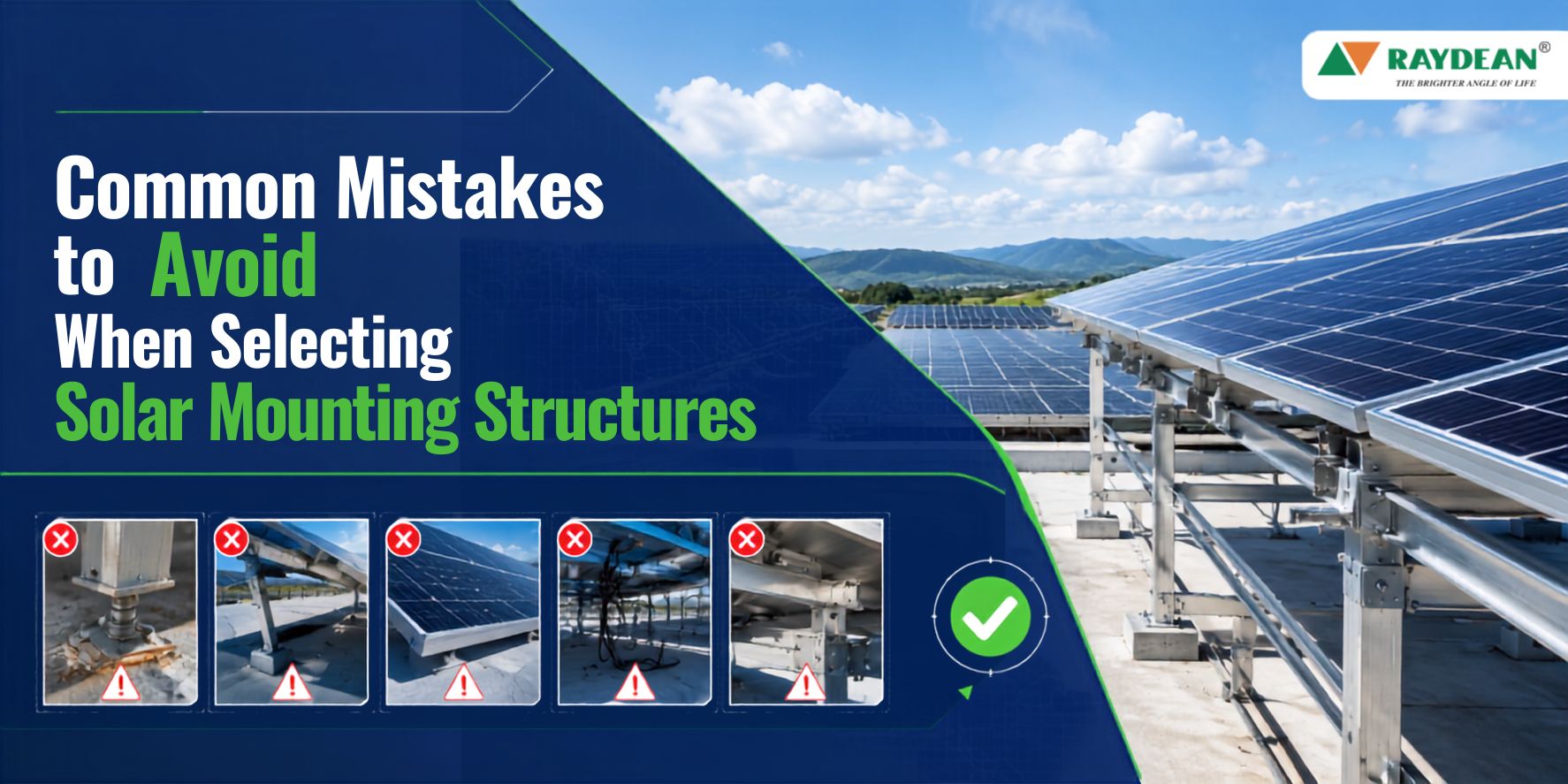
10 Common Mistakes to Avoid When Selecting Solar Mounting Structures
1. Choosing the Structure Based Only on the Lowest Price
One of the biggest mistakes is treating the mounting structure as a commodity and selecting the cheapest quotation.
A lower initial price may result from:
- Lower material thickness
- Inadequate structural design
- Poor-quality fasteners
- Insufficient corrosion protection
- Less bracing
- Inappropriate connection details
- Limited engineering support
- Higher installation or maintenance costs
The cheapest structure is not necessarily the most economical structure over 20 or more years.
What to do instead
Compare suppliers based on total lifecycle value, including:
- Material quality
- Structural design
- Coating and corrosion protection
- Load calculations
- Manufacturing quality
- Installation requirements
- Warranty
- Maintenance
- Supplier experience
- After-sales support
The objective should be maximum value, not minimum purchase price.
2. Ignoring Site-Specific Wind Loads
Wind is one of the most important considerations when designing a solar mounting system.
A structure that performs well at one location may require a different design at another location because wind conditions, terrain, building height, exposure, and installation configuration can vary.
BIS identifies IS 875 (Part 3): 2015 as the Indian Standard covering wind loads for buildings and structures.
Why this mistake is risky
Ignoring applicable wind loads can result in:
- Excessive structural movement
- Fastener failure
- Panel damage
- Uplift problems
- Foundation failure
- Roof damage
- Premature structural deterioration
What to do instead
Ask the manufacturer or structural engineer for project-specific design calculations based on the applicable codes and site conditions. Do not assume that a standard structure is automatically suitable for every location.
3. Selecting the Wrong Material
Material selection directly affects structural strength, durability, weight, fabrication, and corrosion resistance.
Commonly considered materials include:
- Galvanized steel
- Aluminium
- Stainless steel for selected components
- Other engineered steel systems
The right material depends on the application and environmental conditions.
For steel structures, material specifications and structural design should be verified rather than relying only on generic descriptions such as “heavy-duty steel.”
What to check
Before purchasing, ask for:
- Steel grade
- Material thickness
- Relevant material standards
- Coating specification
- Fastener grade
- Quality-control documentation
- Applicable test certificates
A reputable Solar Structure Manufacturer in India should be able to clearly explain the material and coating specifications used in its system.
4. Underestimating Corrosion Protection
Solar mounting structures are exposed to sun, rain, humidity, dust, temperature changes, and, in some locations, aggressive atmospheric conditions.
Poor corrosion protection can reduce the service life of the structure and increase maintenance requirements.
Hot-dip galvanizing is widely used for steel structures because it provides a zinc coating that protects the underlying steel. BIS lists IS 4759:1996 as the specification for hot-dip zinc coatings on structural steel and allied products.
Common corrosion-related mistakes
- Selecting insufficient coating protection
- Ignoring coastal or corrosive environments
- Using incompatible metals without considering galvanic corrosion
- Damaging protective coatings during installation
- Failing to inspect cut edges and damaged areas
- Using poor-quality fasteners
Better approach
Discuss the site’s environmental conditions with your supplier before finalizing the structure.
A good mounting solution should consider the entire corrosion-protection system, not just the appearance of the steel.
5. Not Checking Roof Compatibility
For rooftop solar projects, the structure must work with the existing roof.
Different roofs require different approaches.
| Roof Type | Important Considerations |
| RCC roof | Ballast, anchors, waterproofing and structural capacity |
| Metal sheet roof | Sheet profile, purlins, clamps and fixing method |
| Industrial shed | Existing structural members and load capacity |
| Tiled roof | Tile condition, attachment method and waterproofing |
| Sloped roof | Roof angle, orientation and fixing details |
Raydean states that its rooftop structures can be configured for RCC, metal sheet, industrial shed, tiled and other roof applications, with different fixing methods depending on the roof type.
What to do
Before selecting the system, verify:
- Roof condition
- Existing structural capacity
- Roof material
- Available fixing points
- Waterproofing requirements
- Access for installation
- Maintenance access
- Drainage paths
Never assume that one rooftop mounting design will work equally well on every roof.
6. Ignoring the Solar Panel Dimensions and Configuration
PV modules are not all identical.
Their:
- Length
- Width
- Weight
- Frame design
- Clamping zones
- Mounting holes
- Orientation
- Number of modules per row
can vary.
Using an unsuitable rail or clamp arrangement can create installation difficulties or place unwanted loads on the module frame.
Better approach
Finalize the mounting structure after confirming the actual module datasheet and mounting requirements.
The supplier should verify module compatibility before manufacturing or dispatching the structure.
7. Failing to Consider Foundation and Soil Conditions
For ground-mounted solar projects, the structure is only as reliable as its connection to the ground.
A common mistake is selecting the superstructure without properly evaluating:
- Soil characteristics
- Foundation type
- Ground conditions
- Water table
- Terrain
- Slope
- Pull-out requirements
- Installation equipment
Why this matters
A strong steel structure cannot compensate for an inadequate foundation. Depending on the project, foundation solutions may involve different methods, such as driven piles, concrete foundations or other engineered systems. The appropriate solution should be determined by project-specific engineering rather than simply choosing the cheapest installation method.
8. Overlooking Installation and Maintenance Requirements
A technically strong mounting structure can still become a poor project choice if it is unnecessarily difficult to install or maintain.
Complex structures may increase:
- Installation time
- Labour requirements
- Alignment issues
- On-site modification
- Welding requirements
- Maintenance difficulty
Raydean’s rooftop structure information highlights prefabricated components and installation approaches designed to simplify assembly, depending on the roof and application.
Before buying, ask:
- Can the system be assembled efficiently?
- Does it require on-site welding?
- Are components clearly identified?
- Are installation drawings provided?
- Are standard tools sufficient?
- Can individual components be replaced?
- Is there safe access for future inspection?
Good design considers both manufacturing and installation.
9. Ignoring Quality Control and Manufacturer Capability
Not every supplier has the same engineering, manufacturing, testing, and quality-control capabilities. When comparing the best solar structure manufacturers in India, look beyond marketing claims.
Evaluate:
- Manufacturing infrastructure
- Engineering team
- Production capacity
- Quality-control procedures
- Material traceability
- Project experience
- Certifications
- Delivery capability
- Customization capability
- Technical support
Raydean reports a manufacturing facility in Bagru, Rajasthan, a 250,000 sq. ft. plant, and large-scale structural manufacturing capabilities. The company also states that it has supplied rooftop and ground-mount solar structures at significant project volumes.
These types of credentials can help buyers distinguish an established manufacturer from a trading-only supplier.
10. Not Comparing the Complete Technical Specification
Another common mistake is comparing suppliers only by price per kilogram or price per watt.
A better comparison considers the complete technical package.
Solar Mounting Structure Selection Checklist
| Parameter | What to Check |
| Material | Steel/aluminium grade and specification |
| Coating | Galvanization or other corrosion protection |
| Design | Site-specific structural calculations |
| Wind load | Applicable design wind conditions |
| Roof/soil | Site-specific compatibility |
| Module | Dimensions, weight and clamp requirements |
| Fasteners | Grade, material and corrosion resistance |
| Foundation | Design and installation method |
| Installation | Assembly complexity and tools required |
| Quality | Inspection and testing procedures |
| Warranty | Product and structural warranty terms |
| Support | Engineering and after-sales assistance |
| Delivery | Production capacity and lead time |
This approach makes it easier to compare quotations on a like-for-like basis.
How to Choose the Right Solar Mounting Structure
A reliable selection process can be divided into seven steps.
Step 1: Understand the Project
Identify:
- Rooftop or ground-mounted application
- Project capacity
- Module type
- Site location
- Terrain
- Expected operating conditions
- Installation timeline
Step 2: Assess the Site
Collect relevant information about:
- Wind conditions
- Roof or ground conditions
- Terrain
- Corrosive environment
- Drainage
- Accessibility
- Existing structures
Step 3: Finalize the Module
Confirm the exact PV module dimensions, weight and manufacturer’s mounting requirements.
Step 4: Define the Structural Design
The structure should be engineered for the applicable project loads and conditions.
Indian structural practice references standards including IS 800 and IS 875 for relevant steel design and loading considerations.
Step 5: Evaluate Material and Coating
Check the steel specification, coating system, fasteners and corrosion-protection requirements.
Step 6: Compare Manufacturers
Evaluate suppliers on engineering capability, quality, manufacturing capacity, delivery record, documentation and technical support—not only price.
Step 7: Review the Final Technical Offer
Before placing the order, review:
- Drawings
- Bill of materials
- Structural calculations
- Material specifications
- Coating requirements
- Fastener details
- Foundation design
- Installation method
- Warranty conditions
What Should You Ask a Solar Mounting Structure Manufacturer?
Before finalizing a supplier, ask these questions:
- What material and steel grade do you use?
- What corrosion-protection method is provided?
- What design standards are considered?
- How is the structure designed for site wind conditions?
- Is the design customized for my project?
- Is the structure compatible with my selected modules?
- What foundation or roof-fixing method is recommended?
- What quality checks are performed during manufacturing?
- What technical drawings and documentation will be supplied?
- What warranty and after-sales support are provided?
- What is the expected service life under the specified conditions?
- What is the manufacturer’s production and delivery capacity?
A manufacturer that can answer these questions clearly demonstrates greater technical transparency.
Why Choosing the Right Solar Structure Manufacturer Matters
The mounting structure is a long-term component of a solar project. Replacing it after installation can be expensive and disruptive. Working with an experienced Solar Structure Manufacturer in Rajasthan can be particularly useful for projects requiring local engineering coordination, manufacturing support, customization and faster communication.
For projects around Jaipur, buyers may also consider an established Solar Structure Manufacturer in Jaipur with manufacturing and engineering capabilities suited to the project’s requirements.
Raydean identifies itself as a Jaipur-based company and states that it manufactures solar module mounting structures, telecom structures and transmission-line structures. Its website also reports ISO 9001:2015, ISO 14001:2015 and ISO 45001:2018 certifications.
The right manufacturer should function as a technical partner rather than simply a material supplier.
Manufacturer vs Supplier: What Should You Choose?
The terms manufacturer and supplier are sometimes used interchangeably, but buyers should understand the difference.
A Solar Mounting Structure Supplier in India may source products from one or more manufacturers and coordinate delivery.
A manufacturer, on the other hand, may provide greater control over:
- Product engineering
- Material selection
- Manufacturing
- Quality control
- Customization
- Production schedules
- Technical documentation
For large commercial, industrial and utility-scale projects, direct access to the manufacturer can simplify technical communication and customization.
That does not mean every supplier is unsuitable. The key is to verify who designs, manufactures, tests and supports the product.
Red Flags to Watch for When Buying Solar Mounting Structures
Be cautious when a supplier:
- Cannot provide material specifications.
- Gives the same design for every site.
- Does not ask about wind conditions.
- Does not verify module dimensions.
- Cannot explain the coating system.
- Avoids providing structural calculations.
- Has unclear warranty terms.
- Offers an unusually low price without technical justification.
- Cannot provide installation drawings.
- Has no clear quality-control process.
- Cannot explain who actually manufactures the structure.
These warning signs do not automatically mean a product is defective, but they indicate that additional technical verification is necessary.
A Simple Solar Mounting Structure Buying Checklist
Before approving your purchase, make sure you have verified:
- Project location and environmental conditions
- Roof or soil assessment
- Module dimensions and weight
- Structural design
- Applicable wind and other loads
- Material grade
- Coating specification
- Fastener specification
- Foundation or fixing method
- Installation drawings
- Quality documentation
- Warranty
- Delivery schedule
- Manufacturer or supplier credentials
- Technical and after-sales support
Frequently Asked Questions
1. What are the most common mistakes when selecting solar mounting structures?
The most common mistakes include choosing solely on price, ignoring wind loads, selecting unsuitable materials, overlooking corrosion protection, failing to assess the roof or soil, ignoring module compatibility, and not checking the manufacturer’s engineering and quality capabilities.
2. How do I choose the right solar mounting structure?
Choose a structure based on the project location, roof or ground conditions, module specifications, applicable loads, material, corrosion environment, foundation or fixing method, installation requirements and manufacturer capability. A site-specific engineering assessment is preferable to using a generic design.
3. Which material is best for solar mounting structures?
There is no single material that is best for every project. Galvanized steel is widely used because of its strength and corrosion protection, while aluminium and stainless steel can be suitable for specific applications. Material selection should depend on structural requirements, environment, project design and lifecycle expectations.
4. Why is galvanization important for solar mounting structures?
Galvanization provides a protective zinc coating over steel and helps protect the structure against corrosion. The required coating and protection system should be selected according to the environmental conditions and applicable specifications. BIS identifies IS 4759 for hot-dip zinc coatings on structural steel and allied products.
5. How can I find a reliable Solar Structure Manufacturer in India?
Compare manufacturers based on engineering expertise, manufacturing capacity, material quality, structural design capability, corrosion protection, quality control, certifications, project experience, delivery capability, warranty and technical support. Avoid selecting a manufacturer based only on the lowest quotation.
Conclusion
Selecting a solar mounting structure is a long-term engineering decision—not simply a purchase based on price per kilogram or price per watt.
The most important mistakes to avoid are choosing the cheapest option without comparing specifications, ignoring site-specific loads, overlooking corrosion protection, using an incompatible roof or foundation system, failing to verify module compatibility, and not evaluating the manufacturer’s technical capabilities..
If you are looking for a dependable Solar Structure Manufacturer in India or a Solar Mounting Structure Supplier in India, evaluate the complete technical and commercial proposal before making your decision.
Raydean Enterprises provides solar mounting structure solutions for rooftop and ground-mounted applications and has manufacturing infrastructure in Rajasthan. Its published product range includes rooftop and ground-mount structures designed for different project requirements.
Read More: Fixed Tilt vs Solar Tracker Structures: Which One Is Better?
Categories
- All (6)
- HDG Structure (1)
- Pre Galvanized Structure (1)
- Rooftop Solar Structure (1)
- Solar Mounting Structure (3)
- Transmission Towers (1)