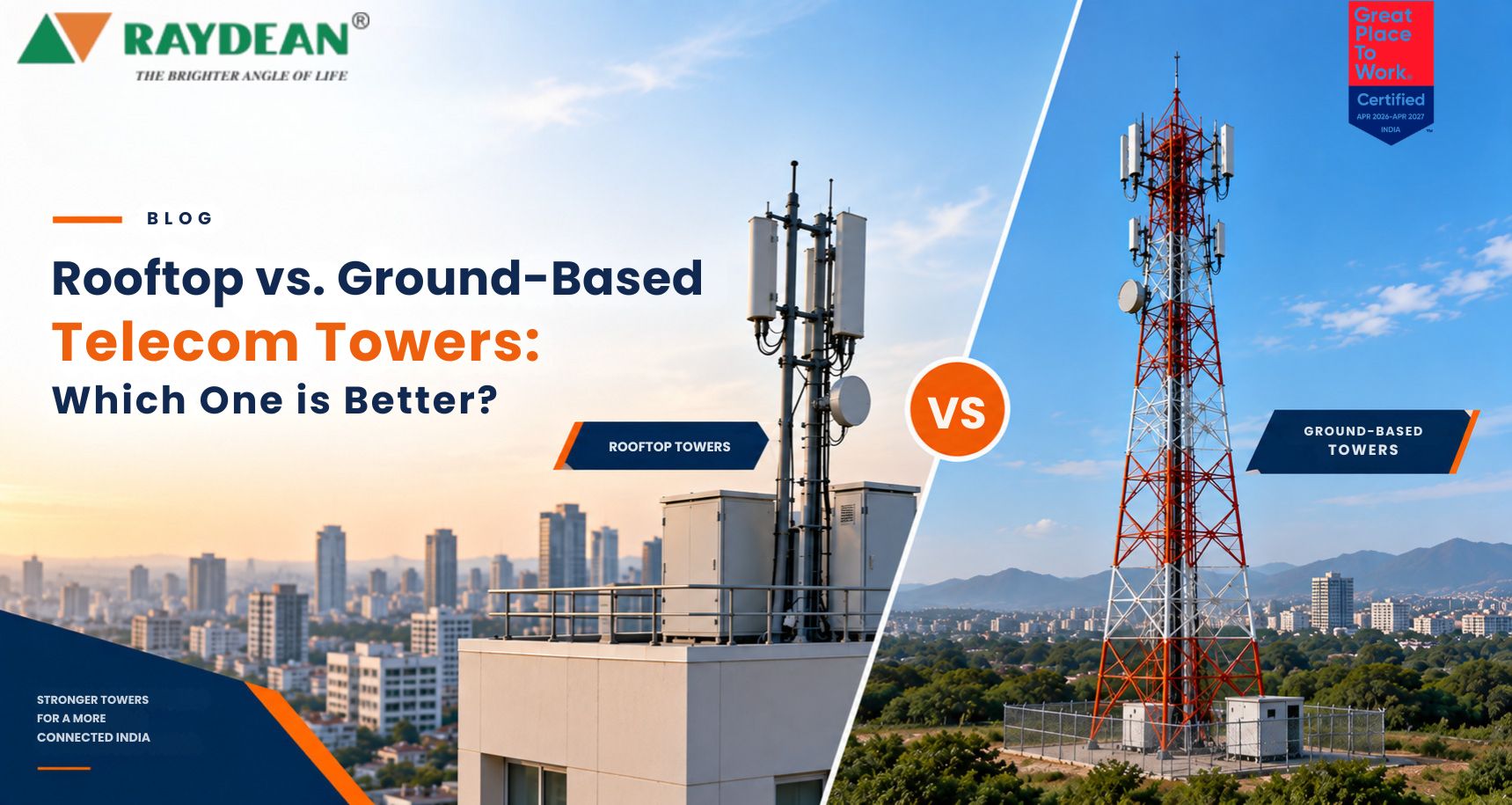
Rooftop vs. Ground-Based Telecom Towers: Which One is Better?
-

-

-

No Comments
Rooftop vs. Ground-Based Telecom Towers: Which One is Better?
Rooftop vs. Ground-Based Telecom Towers: An Overview
Telecom towers are essential infrastructure for maintaining reliable mobile, wireless, and communication networks. As demand for connectivity continues to grow, telecom operators and infrastructure companies must choose the right tower configuration for each site. Two common options are rooftop telecom towers and ground-based telecom towers. A rooftop tower is installed on an existing building or structure, while a ground-based tower is installed directly on a dedicated foundation at ground level. Both solutions can provide effective network coverage, but their suitability depends on factors such as available space, building strength, tower height, wind conditions, access, maintenance requirements, and project economics.
What Is a Rooftop Telecom Tower?
A rooftop telecom tower is a communication tower or mast installed on the roof of an existing building.
These towers are commonly used in:
- Cities and metropolitan areas
- Commercial buildings
- Apartment complexes
- Industrial buildings
- Office buildings
- Hospitals and institutional buildings
- Areas where land availability is limited
Instead of acquiring additional land, the telecom infrastructure uses the existing building footprint. However, rooftop installation requires careful structural assessment. The building must be capable of safely supporting the additional dead load, wind load, equipment load, and dynamic effects associated with the tower.
Key Features of Rooftop Telecom Towers
- Efficient use of existing space
- Suitable for urban locations
- Reduced requirement for additional land
- Installation on existing buildings
- Access to elevated mounting height
- Requires building structural assessment
- Can be suitable for compact telecom equipment
The design must account for both the tower and the building on which it is installed.
What Is a Ground-Based Telecom Tower?
A ground-based telecom tower is installed on a dedicated foundation constructed at ground level. Depending on the project requirements, different tower configurations can be considered, including lattice towers and monopole-based solutions.
Ground-based towers are commonly used for:
- Rural telecom networks
- Highways and transportation corridors
- Industrial areas
- Large campuses
- Utility infrastructure
- Open land
- Large-scale network deployments
Because the tower has its own foundation, engineers have greater control over the foundation system and structural configuration. Ground-mounted infrastructure is also familiar across the renewable-energy industry. For example, MNRE’s current national data separates India’s solar capacity into ground-mounted and grid-connected rooftop categories; as of August 31, 2026, India had 123.99 GW of ground-mounted solar and 32.59 GW of grid-connected rooftop solar capacity.
This illustrates an important infrastructure principle: the right mounting configuration depends heavily on the characteristics and constraints of the site.
Rooftop vs. Ground-Based Telecom Towers: Key Differences
| Factor | Rooftop Telecom Tower | Ground-Based Telecom Tower |
| Installation location | Existing building roof | Dedicated ground foundation |
| Land requirement | Low | Higher |
| Building assessment | Essential | Not applicable to building |
| Foundation | Connected to/located on building structure | Dedicated foundation |
| Urban suitability | High | Depends on land availability |
| Installation flexibility | Moderate | High |
| Tower height | Limited by building and design constraints | More flexible |
| Maintenance access | Depends on building access | Usually easier to plan |
| Future expansion | Site-dependent | Generally more flexible |
| Structural considerations | Building + tower interaction | Tower + foundation + soil |
| Typical application | Dense urban areas | Rural, industrial and open areas |
Rooftop Telecom Towers: Advantages and Limitations
Advantages of Rooftop Telecom Towers
1. Efficient Use of Space
One of the biggest benefits is that rooftop towers use an existing building rather than requiring a separate plot of land. This can be particularly useful in densely populated cities where acquiring additional land for telecom infrastructure can be challenging.
2. Suitable for Urban Deployment
Rooftop installations can help telecom operators deploy equipment closer to areas with high network demand. They may be useful where buildings already provide sufficient elevation for antennas.
3. Reduced Land Requirement
Since the installation is located on an existing structure, there is generally no need to develop a separate ground-level telecom site.
4. Potentially Faster Site Deployment
Where a suitable building already exists and structural approvals are completed, rooftop deployment can simplify the site-development process. However, installation timelines still depend on structural assessments, permissions, access, fabrication, and site conditions.
Limitations of Rooftop Telecom Towers
1. Structural Capacity Is Critical
The building must be assessed before installation.
- Existing structural condition
- Additional dead load
- Wind loads
- Equipment loads
- Anchor or connection details
- Seismic considerations where applicable
- Existing modifications
- Long-term structural performance
A rooftop tower should never be selected simply because a building has enough roof space.
2. Limited Tower Configuration
The available roof area, building geometry, and structural capacity can restrict tower size and equipment placement.
3. Maintenance Access
Maintenance teams may need controlled access through the building, which can make servicing more complicated than at some ground-based sites.
4. Building-Specific Risks
Any structural weakness, water leakage, unauthorized modification, or deterioration of the building can affect the telecom installation.
Ground-Based Telecom Towers: Advantages and Limitations
Advantages of Ground-Based Telecom Towers
1. Greater Structural Flexibility
A dedicated ground foundation allows the tower to be designed specifically for the site.
- Soil conditions
- Tower height
- Wind loads
- Antenna configuration
- Equipment loading
- Foundation requirements
- Site access
2. Suitable for Larger Installations
Ground-based towers can be appropriate when a project requires greater structural capacity, multiple antennas, or additional telecom equipment.
3. Easier Site Planning
A dedicated plot provides greater freedom for positioning the tower, equipment cabinets, fencing, access pathways, and other supporting infrastructure.
4. Easier Future Expansion
When sufficient land is available, future equipment additions or modifications may be easier to accommodate.
Limitations of Ground-Based Telecom Towers
1. Requires Land
The biggest constraint is the need for a suitable ground-level site. In urban locations, land costs and availability can make this option more challenging.
2. Additional Civil Work
A ground-based installation generally requires foundation construction and site preparation. Depending on the site, this can include:
- Excavation
- Foundation construction
- Earthing
- Equipment foundations
- Access arrangements
- Fencing
- Drainage
- Site development
3. Planning and Permissions
The project may require land-related permissions, local approvals, and other site-specific clearances.
Rooftop vs. Ground-Based Telecom Towers: Cost Comparison
Cost is an important consideration, but it should not be evaluated only based on tower fabrication.
- Tower or mast fabrication
- Structural engineering
- Foundation or mounting system
- Transportation
- Installation
- Civil works
- Electrical and earthing works
- Antenna mounting
- Access systems
- Inspection and testing
- Long-term maintenance
A rooftop tower may reduce the need for additional land and some ground-level civil works. However, structural strengthening or specialized rooftop connections can increase costs. A ground-based tower may require more civil work and land, but its dedicated foundation can provide greater design flexibility.
Structural Design: The Most Important Consideration
Whether a telecom tower is installed on a roof or on the ground, structural engineering is critical.
For Rooftop Towers
Engineers should evaluate:
- Building structural drawings
- Roof slab condition
- Columns and beams
- Existing load capacity
- Tower connection points
- Wind loads
- Antenna loads
- Equipment loads
- Structural stability
- Waterproofing considerations
For Ground-Based Towers
The design should consider:
- Soil investigation
- Foundation type
- Tower height
- Wind speed
- Antenna arrangement
- Equipment loading
- Foundation reactions
- Corrosion protection
- Drainage
- Earthing
- Site accessibility
The tower, foundation, and mounting arrangement should be treated as an integrated structural system rather than isolated components.
How Solar Mounting Structures Relate to Telecom Infrastructure
Telecom towers and solar mounting structures serve different purposes, but both depend heavily on structural engineering, material selection, corrosion protection, load calculations, and site-specific design.
A Rooftop Solar Structure in India can be used where suitable roof space is available, while a Ground Mount Solar Structure in India can be considered when dedicated ground space is available. Raydean provides solar power plant solutions covering rooftop, ground-mounted, and utility-scale applications, with mounting structures forming part of its broader solar infrastructure offering.
Rooftop Solar Structure in India vs. Ground Mount Solar Structure in India
The choice between rooftop and ground-mounted solar structures follows a similar site-selection principle.
| Parameter | Rooftop Solar Structure | Ground Mount Solar Structure |
| Location | Building roof | Ground |
| Land requirement | Very low | Higher |
| Roof assessment | Required | Not required |
| Site flexibility | Moderate | High |
| Maintenance access | Site-dependent | Generally easier |
| Expansion | Limited by roof area | More flexible |
| Typical application | Homes, commercial buildings, factories | Solar farms, open land, industrial projects |
This is why selecting the right Solar Mounting Structure Manufacturer is important for both structural performance and project reliability. A competent Solar Structure Manufacturer in India should be able to understand site-specific requirements rather than supplying a generic structure for every application.
What Makes the Best Solar Structure in India?
Although this article focuses on telecom towers, solar structures often operate alongside telecom infrastructure. When selecting a solar mounting system, consider:
Material Quality
The structure should use materials appropriate for the expected structural and environmental loads.
Corrosion Protection
Hot-dip galvanization and suitable protective systems can help improve durability, particularly in demanding outdoor environments.
Engineering Design
The structure should be designed according to project-specific loading, module dimensions, installation configuration, and site conditions.
Installation Quality
Even a well-designed structure can underperform if installation, connections or foundation work is inadequate.
Long-Term Reliability
The objective should be a durable mounting system that supports the solar modules throughout their intended service life. For buyers comparing suppliers, terms such as solar structure manufacturer in India should be evaluated through measurable factors such as manufacturing capability, engineering expertise, quality systems, project experience, material specifications, and after-sales support.
How to Choose a Solar Structure Manufacturer for Telecom-Integrated Projects
If a telecom site also requires solar infrastructure, evaluate the supplier on several parameters.
1. Manufacturing Capacity
Large projects require consistent production capacity, quality control, and delivery capability. Raydean states that its manufacturing operations include a 250,000 sq. ft. facility in Bagru, Rajasthan, with reported structural steel production capacity of up to 8,000 MT per month.
2. Product Range
A capable supplier should be able to support different project configurations, including rooftop and ground-mounted systems.
3. Engineering Expertise
Ask whether the supplier provides engineering support based on actual site conditions and project loads.
4. Quality and Standards
Check the applicable Indian and international standards, material grades, galvanization requirements, and quality-control procedures for the specific project.
5. Project Experience
Experience across different site conditions can help a manufacturer understand practical installation and logistics challenges.
6. Supply and Delivery Capability
For large projects, manufacturing capacity and supply-chain reliability can be just as important as product specifications.
A Ground Mount Solar Structure Manufacturer in India serving utility-scale projects, for example, may need significantly different manufacturing and logistics capabilities from a supplier focused on small residential rooftop installations.
What Should You Check Before Selecting a Telecom Tower?
Before deciding between rooftop and ground-based installation, consider these questions:
Site
- Is suitable land available?
- Is there an existing building with adequate structural capacity?
- Is the site accessible for installation equipment?
Structural Requirements
- What tower height is required?
- What antenna configuration is planned?
- What wind loads apply?
- What equipment will be installed?
Cost
- What is the land cost?
- Is structural strengthening required?
- What civil works are necessary?
- What are the transportation and installation costs?
Maintenance
- Can technicians access the site safely?
- Is there sufficient working space?
- How easily can equipment be replaced?
Future Expansion
- Are additional antennas expected?
- Is additional equipment likely to be installed?
- Is there enough structural and spatial capacity for future upgrades?
Which Telecom Tower Is Better for Urban Areas?
In urban environments, rooftop telecom towers can be practical because they use existing buildings and reduce the requirement for separate land. However, suitability depends on the structural capacity of the building, available roof area, required tower configuration, and local site conditions. Where an appropriate building is unavailable—or where the required installation exceeds the building’s structural or spatial limitations—a ground-based solution may be considered.
Which Telecom Tower Is Better for Rural Areas?
Ground-based telecom towers are often considered for rural and open sites because land can be more readily available and a dedicated foundation can be developed. They can also provide greater flexibility for tower height, equipment placement, and future expansion.
Rooftop vs. Ground-Based Telecom Towers: Decision Checklist
Use the following checklist when evaluating both options:
Choose a rooftop solution when:
- Suitable buildings are already available.
- Land availability is limited.
- Urban deployment is required.
- The building has adequate structural capacity.
- The proposed tower and equipment loads can be safely accommodated.
Consider a ground-based solution when:
- Suitable land is available.
- Greater structural flexibility is required.
- A larger tower configuration is planned.
- Future expansion is expected.
- A dedicated foundation and equipment area are preferred.
The final selection should be based on engineering assessment, site conditions, project requirements, and applicable regulations.
Why Choosing the Right Manufacturer Matters
Telecom towers and solar mounting structures are long-term infrastructure investments. The quality of the steel, fabrication, connections, protective coating, engineering, and installation can directly affect durability and maintenance requirements. For solar projects, a reliable Solar Structure Supplier in India should provide more than fabricated steel. Buyers should evaluate engineering support, quality assurance, production capacity, and project-specific customization.
For international projects, a capable Solar Structure Exporter should also understand packaging, documentation, international specifications, logistics, and destination-country requirements.
Rooftop vs. Ground-Based Telecom Towers: Frequently Asked Questions
1. What is the difference between a rooftop and ground-based telecom tower?
A rooftop telecom tower is installed on an existing building, while a ground-based telecom tower is installed on a dedicated ground-level foundation. Rooftop towers can be useful in space-constrained urban areas, while ground-based towers provide greater site and foundation flexibility where land is available.
2. Are rooftop telecom towers safe?
Rooftop telecom towers can be safe when properly designed and installed. The building’s structural capacity, tower loads, wind loads, connection details, and other relevant engineering requirements should be assessed before installation.
3. Are ground-based telecom towers better than rooftop towers?
Neither option is universally better. The appropriate solution depends on land availability, building capacity, required tower configuration, structural requirements, installation conditions, and future expansion plans.
4. What is a Ground Mount Solar Structure in India?
A Ground Mount Solar Structure in India is a structural framework used to install solar PV modules on the ground. It is commonly used for open-land, commercial, industrial, and utility-scale solar projects.
5. How do I choose a Solar Structure Manufacturer in India?
Evaluate the manufacturer’s engineering capabilities, material quality, manufacturing capacity, corrosion protection, quality systems, customization options, project experience, and ability to meet project-specific requirements. For larger projects, also assess production and delivery capacity.
Conclusion
The choice between rooftop and ground-based telecom towers is ultimately a site-specific engineering decision. The same principle applies to solar infrastructure. Choosing between a Rooftop Solar Structure in India and a Ground Mount Solar Structure in India depends on available space, structural requirements, project scale, installation conditions, and long-term objectives.
Whether you are developing telecom infrastructure, a rooftop solar project, or a utility-scale solar plant, selecting an experienced Solar Mounting Structure Manufacturer and infrastructure partner can help ensure that the structural solution is designed around the actual project requirements.
Read More: Best Telecom Tower Manufacturer in India for Infrastructure Projects
Categories
- All (8)
- HDG Structure (1)
- Pre Galvanized Structure (1)
- Rooftop Solar Structure (1)
- Solar Mounting Structure (3)
- Transmission Towers (1)
- Telecom Tower (2)