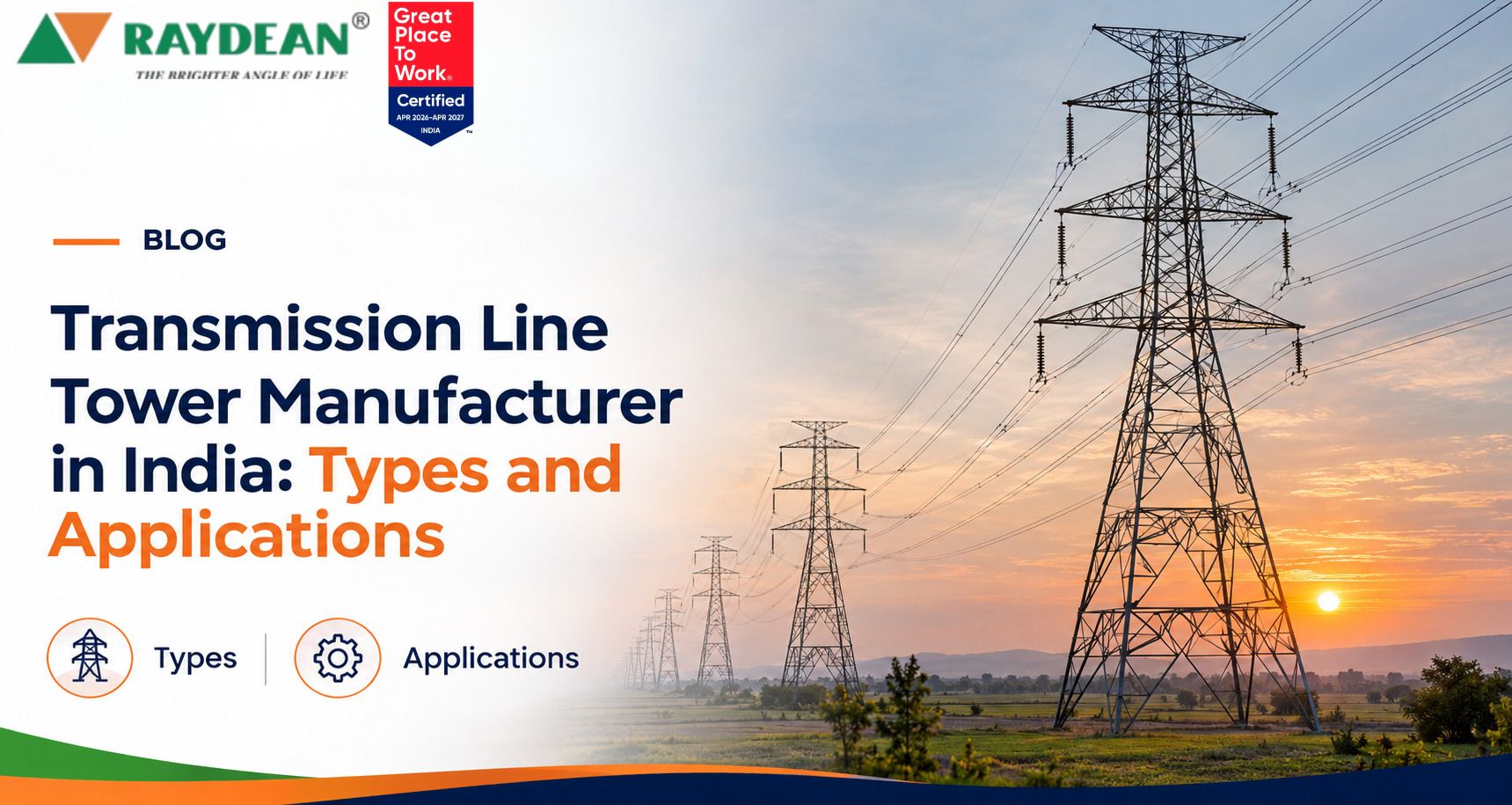
Transmission Line Tower Manufacturer in India: Types and Applications
-

-

-

No Comments
Transmission Line Tower Manufacturer in India: Types and Applications
India’s growing demand for electricity has increased the need for reliable power transmission infrastructure. From industrial facilities and commercial buildings to residential areas and renewable energy projects, a strong transmission network plays an essential role in delivering electricity safely over long distances. Transmission line towers are a critical part of this infrastructure, supporting overhead conductors and maintaining the required electrical clearances.
Choosing the right Transmission Line Tower Manufacturer in India is important for ensuring structural strength, long-term durability, and dependable performance. Manufacturers must focus on quality materials, precision engineering, corrosion protection, and project-specific requirements.
Raydean Enterprises is contributing to India’s infrastructure development through advanced steel manufacturing capabilities and engineered transmission line structures designed for diverse project applications.
What Are Transmission Line Towers?
Transmission line towers are tall steel structures used to support overhead electrical conductors that carry electricity from generating stations to substations and distribution networks. They maintain the necessary distance between conductors, the ground, and surrounding structures.
These towers are generally manufactured using high-strength structural steel and designed to withstand wind pressure, conductor loads, environmental conditions, and other structural forces.
Depending on voltage requirements, geographical conditions, and project specifications, transmission towers are available in different designs and configurations.
Types of Transmission Line Towers and Their Applications
Understanding different tower types helps project developers select the right structure for their power transmission requirements.
1. Suspension Towers
Suspension towers are commonly installed along straight transmission line routes where there is little or no change in direction. They support conductors using suspension insulator strings and primarily withstand vertical and transverse loads.
Applications:
- Long-distance overhead power transmission.
- Straight transmission line sections.
- Rural and urban electricity networks.
- High-voltage transmission corridors.
2. Tension or Angle Towers
Tension towers are designed to withstand greater mechanical loads and maintain conductor tension. They are installed where transmission lines change direction or where additional structural support is required.
Applications:
- Transmission line route deviations.
- Sections with higher mechanical loading.
- River and road crossing arrangements.
- Locations requiring stronger conductor support.
3. Dead-End Towers
Dead-end towers are heavy-duty structures installed at the termination of transmission lines or at important section points. They withstand the longitudinal pull of conductors and provide reliable anchoring.
Applications:
- Transmission line termination points.
- Substation entry and exit connections.
- Sectionalising points.
- Locations requiring high longitudinal load resistance.
4. Transposition Towers
Transposition towers are specially designed to change the relative positions of electrical phases along a transmission line. This arrangement helps balance electrical characteristics across long transmission circuits when required by system design.
Applications:
- Long-distance transmission networks.
- High-voltage and extra-high-voltage lines.
- Projects requiring phase transposition arrangements.
5. Monopole Towers
Monopole towers are single-pole steel structures that require comparatively less ground space than conventional lattice towers. Their compact footprint makes them suitable for locations where land availability and right-of-way restrictions are important considerations.
Applications:
- Urban power transmission corridors.
- Space-constrained locations.
- Roadside transmission infrastructure.
- Projects requiring compact structural designs.
Major Applications of Transmission Line Towers
Transmission towers support several essential sectors of India’s electricity and infrastructure ecosystem.
- Power Generation and Transmission: Transport electricity from power plants to substations and major consumption centres.
- Renewable Energy Projects: Connect solar parks and wind farms to grid infrastructure through dedicated power evacuation lines.
- Industrial Infrastructure: Support reliable electricity transmission for manufacturing facilities, industrial parks, and large commercial developments.
- Urban Electrification: Enable high-voltage power networks in expanding cities and developing urban regions.
- Rural Electrification: Strengthen electricity connectivity across villages, remote locations, and developing regions.
Key Factors to Consider When Choosing a Transmission Tower Manufacturer
Selecting reliable transmission line tower suppliers in India requires evaluating more than just product pricing. Important factors include:
- Material Quality: Structural steel should meet the applicable project specifications and relevant Indian Standards.
- Engineering Expertise: Tower designs should account for voltage levels, wind loads, terrain, conductor configurations, and structural requirements.
- Corrosion Protection: Hot-dip galvanization helps protect steel components against corrosion and supports longer service life.
- Manufacturing Capacity: Adequate production infrastructure is essential for meeting bulk orders and project deadlines.
- Quality Assurance: Inspection, dimensional accuracy, fabrication quality, and testing requirements should be addressed throughout production.
- Customization: Manufacturers should be capable of producing structures according to approved engineering drawings and project specifications.
Why Choose Raydean Enterprises for Transmission Line Steel Structures?
Raydean Enterprises is an established Indian steel infrastructure manufacturer with manufacturing operations in Bagru, Rajasthan. The company supports the growing requirements of the power transmission, renewable energy, telecommunications, and infrastructure sectors.
As a Transmission Tower Manufacturer in Jaipur, Raydean Enterprises combines engineering capabilities with modern manufacturing infrastructure to deliver steel structures for diverse project requirements.
Key manufacturing strengths include:
- A 250,000 sq. ft. manufacturing facility in Bagru, Rajasthan.
- A qualified workforce of more than 800 professionals.
- Structural steel manufacturing capacity of up to 8,000 MT per month.
- In-house galvanizing facilities with a reported capacity of 200 MT per day.
- Engineering capabilities covering 3D modelling, structural analysis, detailed engineering, and fabrication drawings.
- Manufacturing solutions designed around project specifications and quality requirements.
These capabilities strengthen Raydean’s position as a reliable Transmission Line Tower Manufacturer in Rajasthan, serving infrastructure requirements across India.
For projects requiring dependable Transmission Line Steel Structures, Raydean focuses on structural performance, manufacturing precision, corrosion protection, and consistent production quality.
Conclusion
Transmission line towers are essential for building a reliable and efficient electricity network. From suspension and tension towers to dead-end structures and monopoles, each design serves a specific purpose in power transmission infrastructure.
Choosing an experienced manufacturer helps ensure that tower structures meet engineering requirements, withstand environmental conditions, and deliver dependable long-term performance.
Raydean Enterprises brings together engineering expertise, advanced manufacturing infrastructure, and steel fabrication capabilities to support India’s growing power transmission requirements. Whether you are looking for a Transmission Tower Exporter or a dependable manufacturing partner for domestic infrastructure projects, Raydean offers manufacturing capabilities designed to support diverse project needs.
Looking for a reliable transmission tower manufacturing partner? Connect with Raydean Enterprises today to discuss your project requirements and explore customized transmission line steel structure solutions.
Frequently Asked Questions (FAQs)
1. What are the different types of transmission line towers?
The main types include suspension towers, tension or angle towers, dead-end towers, transposition towers, and monopole towers. Each type serves a specific purpose depending on transmission route conditions and structural requirements.
2. What materials are used to manufacture transmission line towers?
Transmission towers are generally manufactured using structural steel sections and plates. The steel grade, fabrication requirements, and corrosion protection must comply with applicable project specifications and relevant standards.
3. How do I choose the best transmission line tower manufacturer in India?
Consider the manufacturer’s engineering expertise, steel quality, manufacturing capacity, galvanizing facilities, quality control processes, customization capabilities, and experience with infrastructure projects.
4. Why is galvanization important for transmission towers?
Hot-dip galvanization provides a protective zinc coating that helps prevent corrosion and improves the durability of steel structures exposed to outdoor weather conditions.
5. Does Raydean Enterprises manufacture transmission line steel structures?
Yes. Raydean Enterprises manufactures transmission line structures as part of its steel infrastructure solutions, supported by engineering capabilities and manufacturing facilities in Rajasthan.
Read More: What Is Agrivoltaics? Benefits of Solar Farming| Raydean
Categories
- All (18)
- HDG Structure (1)
- Pre Galvanized Structure (2)
- Rooftop Solar Structure (2)
- Solar Mounting Structure (7)
- Transmission Towers (3)
- Telecom Tower (3)
- Solar Structure (1)
- Agrivoltaics (1)
- PM Surya Ghar Yojana (1)
- Ground based telecom tower (1)