
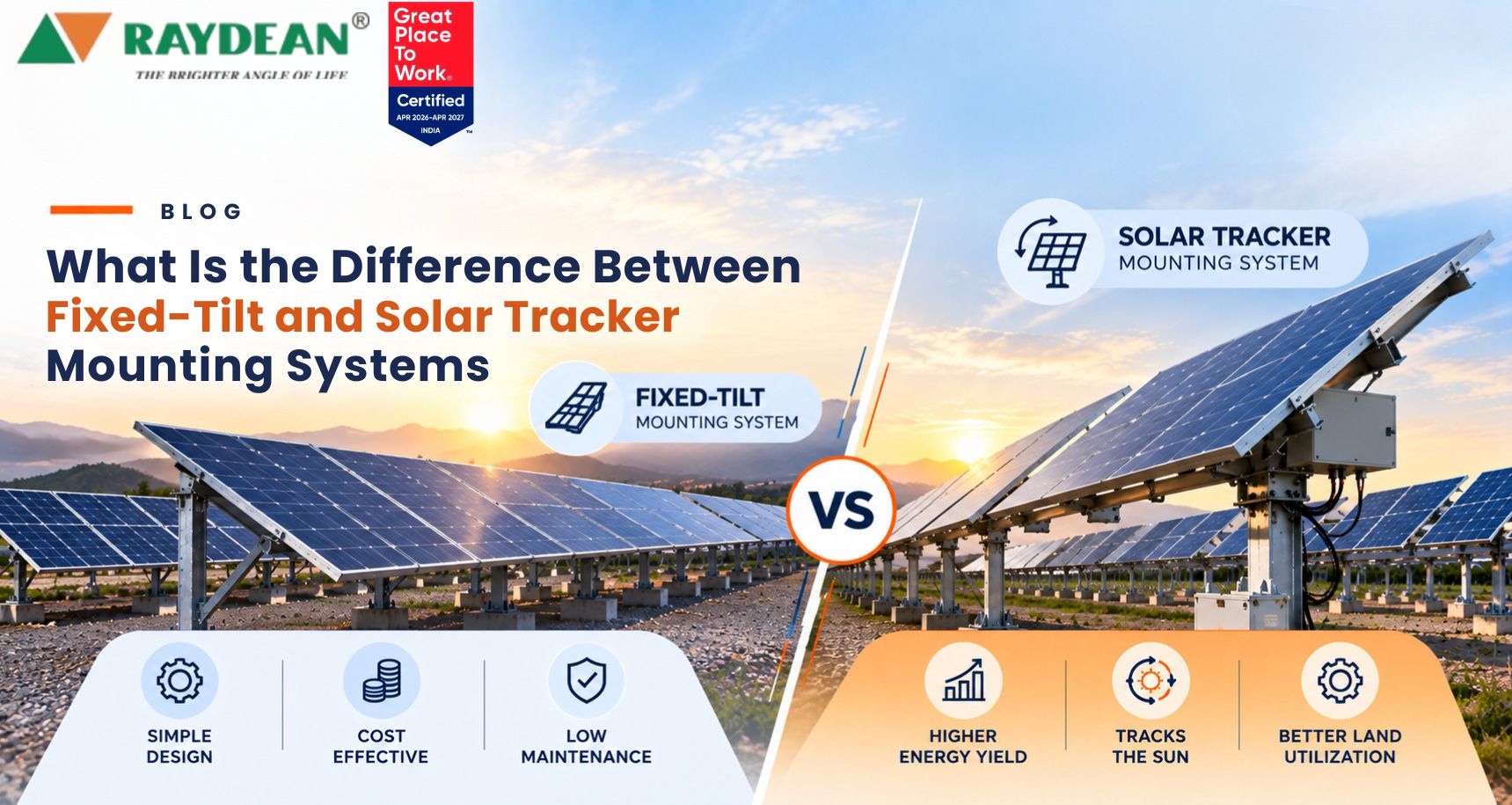
What Is the Difference Between Fixed-Tilt and Solar Tracker Mounting Systems?
-

-

-

No Comments


What Is the Difference Between Fixed-Tilt and Solar Tracker Mounting Systems?
Choosing the right solar mounting system is essential for improving energy generation, controlling installation costs, and ensuring long-term project performance. Two widely used options are fixed-tilt mounting systems and solar tracker mounting systems. Both support solar panels, but they differ in design, movement, efficiency, and overall investment. Understanding the difference between fixed-tilt and solar tracker helps homeowners, businesses, solar developers, and EPC contractors select the right solution for their projects. This guide explains how each system works, compares its advantages and limitations, and helps you identify the most suitable solar mounting structure for your requirements.
What Is a Fixed-Tilt Solar Mounting System?
A fixed-tilt solar mounting system holds solar panels at a predetermined angle and orientation. Once installed, the panels remain in the same position throughout the year, allowing them to capture sunlight without mechanical movement.
Fixed-tilt structures are widely used on residential rooftops, commercial installations, industrial facilities, and ground-mounted solar power plants.
Key Advantages of Fixed-Tilt Systems
- Lower installation costs: These systems generally require fewer components and less complex engineering.
- Low maintenance: With no tracking motors or moving mechanisms, maintenance requirements are relatively low.
- Reliable performance: A properly engineered structure provides long-term stability under site-specific wind and environmental conditions.
- Simpler installation: Standardized designs can reduce installation complexity and project timelines.
Fixed-tilt systems are often considered among the Best Solar Mounting Structures for projects where affordability, durability, and straightforward maintenance are priorities.
What Is a Solar Tracker Mounting Structure?
A Solar Tracker Mounting Structure is designed to move solar panels throughout the day so they can follow the sun’s apparent movement across the sky. By adjusting panel orientation, tracking systems can capture more direct sunlight than comparable fixed-tilt systems under suitable conditions.
Solar trackers are commonly used in utility-scale solar power plants and large ground-mounted installations where the added energy generation justifies the higher initial investment.
Types of Solar Tracking Systems
1. Single-axis solar trackers
Single-axis trackers rotate solar panels around one axis, typically following the sun from east to west. They are widely used in large solar farms because they balance additional energy generation with system complexity.
2. Dual-axis solar trackers
Dual-axis trackers adjust panels along two axes to follow the sun more precisely. Although they can improve solar alignment, their greater mechanical complexity and cost often limit their use to specialized applications.
Key Advantages of Solar Tracker Systems
- Increased energy generation potential compared with fixed-tilt systems.
- Better utilization of available sunlight under suitable site conditions.
- Potentially improved project economics where additional electricity has sufficient financial value.
However, trackers require more engineering, moving components, maintenance, and careful site assessment.
Fixed-Tilt vs. Solar Tracker Mounting Systems: Key Differences
The primary difference is that fixed-tilt systems maintain a constant panel angle, while solar trackers adjust panel orientation to follow the sun.
| Comparison Factor | Fixed-Tilt System | Solar Tracker System |
| Panel movement | No movement | Automatic movement |
| Initial investment | Generally lower | Generally higher |
| Energy generation | Stable, site-dependent output | Potentially higher output |
| Maintenance | Relatively low | Higher due to moving parts |
| Structural complexity | Simpler design | More complex engineering |
| Land requirements | Depends on layout and spacing | May require additional spacing and access |
| Suitable applications | Rooftops, commercial sites, solar farms | Primarily large ground-mounted projects |
| Operational requirements | Relatively simple | Requires controls and mechanical components |
Actual performance depends on location, shading, system design, weather, land availability, and installation quality.
Which Solar Mounting System Is More Efficient?
Solar tracker systems can generate more electricity than fixed-tilt systems because they adjust panel orientation throughout the day. However, the actual energy gain varies by location, technology, and project configuration. Trackers do not guarantee a specific percentage increase in every installation. Fixed-tilt systems can still deliver excellent performance when their tilt angle, orientation, spacing, and shading conditions are properly optimized.
For rooftop installations, the best solar mounting structure for rooftop applications is generally selected according to available roof space, load-bearing capacity, wind exposure, waterproofing requirements, and the roof’s orientation. For large solar farms, the best ground-mounted solar structures depend on land conditions, project capacity, energy-generation targets, maintenance access, and the project’s financial model.
The right solution is therefore not always the system that generates the most electricity. It is the system that delivers the best balance of energy output, investment, reliability, and long-term operating costs.
How to Choose the Right Solar Mounting Structure
Before selecting a mounting system, evaluate the following factors:
1. Project Size and Location
Small residential and commercial projects often benefit from fixed-tilt systems. Large utility-scale installations may justify trackers when local solar conditions and project economics support their use.
2. Budget and Return on Investment
Fixed-tilt structures generally involve lower upfront costs. Trackers require a higher initial investment, so developers should compare additional energy revenue against installation, maintenance, and operating expenses.
3. Wind Loads and Structural Strength
Mounting structures must be engineered for local wind loads, foundation conditions, corrosion exposure, and applicable design standards. Material quality and fabrication precision are critical for long-term structural safety.
4. Maintenance and Durability
Fixed-tilt systems usually have fewer maintenance requirements. Tracker systems need additional inspections of motors, drives, bearings, controls, and moving connections.
5. Manufacturing and Engineering Capabilities
Working with an experienced Solar Structure Manufacturer in India helps project developers obtain structures designed for site conditions and project specifications. For projects in Rajasthan, a Solar Structure Manufacturer in Jaipur may also provide convenient coordination for regional fabrication, supply, and installation requirements.
Why Choose the Right Solar Structure Manufacturer?
A reliable solar mounting structure is more than a steel framework. It must combine structural integrity, material quality, precise fabrication, and practical installation requirements.
When evaluating a Solar Structure Supplier, consider:
- Experience in rooftop and ground-mounted solar projects.
- Quality of steel, protective coatings, and fabrication.
- Compliance with applicable structural and project specifications.
- Customization capabilities for different site conditions.
- Manufacturing capacity and delivery timelines.
- Technical support and coordination with EPC contractors.
An experienced EPC Steel Structure Manufacturer can support projects requiring engineered steel fabrication, while an EPC Infrastructure Manufacturer may offer broader capabilities for complex infrastructure developments.
For solar developers, choosing a capable manufacturing partner can help reduce installation challenges, improve structural reliability, and support project delivery.
Conclusion: Fixed-Tilt and Solar Tracker—Which Is Better?
Fixed-tilt and solar tracker mounting systems serve different project needs. Fixed-tilt structures are generally more affordable, simpler to maintain, and suitable for rooftop, commercial, and many ground-mounted installations. Solar trackers can increase energy generation by following the sun, making them attractive for large solar farms where the additional investment is justified.
Raydean supports the solar and infrastructure sector with a focus on engineered steel structure solutions. If you are planning a rooftop or ground-mounted solar project, evaluate your site requirements and choose a mounting solution that balances performance, durability, and cost-effectiveness.
Looking for a reliable solar structure manufacturing partner in India? Contact Raydean to discuss your project requirements and explore a suitable structural solution.
Frequently Asked Questions (FAQs)
1. What is the main difference between fixed-tilt and solar tracker mounting systems?
Fixed-tilt systems keep solar panels at a constant angle, while solar trackers automatically adjust panel orientation to follow the sun. Fixed-tilt systems are generally less expensive, whereas trackers can increase energy generation under suitable conditions.
2. Do solar trackers generate more electricity than fixed-tilt systems?
Solar trackers can generate more electricity by improving panel alignment with the sun. However, the actual gain depends on geographical location, tracker technology, weather, shading, and system design.
3. Which solar mounting structure is best for rooftop installations?
Fixed-tilt mounting structures are generally suitable for rooftop solar installations because they are simple, cost-effective, and require relatively little maintenance. The final design must account for roof strength, wind loads, waterproofing, and panel orientation.
4. Are solar tracker mounting structures worth the additional cost?
Solar trackers can be worthwhile for large ground-mounted projects when additional electricity generation offsets their higher installation and maintenance costs. A project-specific financial assessment is recommended before making a decision.
5. How do I choose a solar structure manufacturer in India?
Evaluate the manufacturer’s engineering expertise, steel quality, fabrication standards, structural design capabilities, project experience, and delivery reliability. Select a manufacturer that can meet your project’s technical specifications and applicable safety requirements.
To Know More: What Is Agrivoltaics? Benefits of Solar Farming| Raydean
Categories
- All (18)
- HDG Structure (1)
- Pre Galvanized Structure (1)
- Rooftop Solar Structure (2)
- Solar Mounting Structure (9)
- Transmission Towers (2)
- Telecom Tower (2)
- EPC (2)
- PM Surya Ghar Yojhna (1)
- Agrivoltaics (1)
- Solar Tracker (1)
Latest Post


Popular Tags
- Monopole Transmission Tower in india
- Agrivoltaics Structure Manufacturer in India
- HDG Structure vs. Pre-Galvanized Structure
- Lattice Transmission Towers in india
- Solar Structure Manufacturer
- HDG structure in jaipur
- best telecom tower manufacturer
- Solar Structure for Agriculture
- Pre-Galvanized Structure
- telecom tower structure