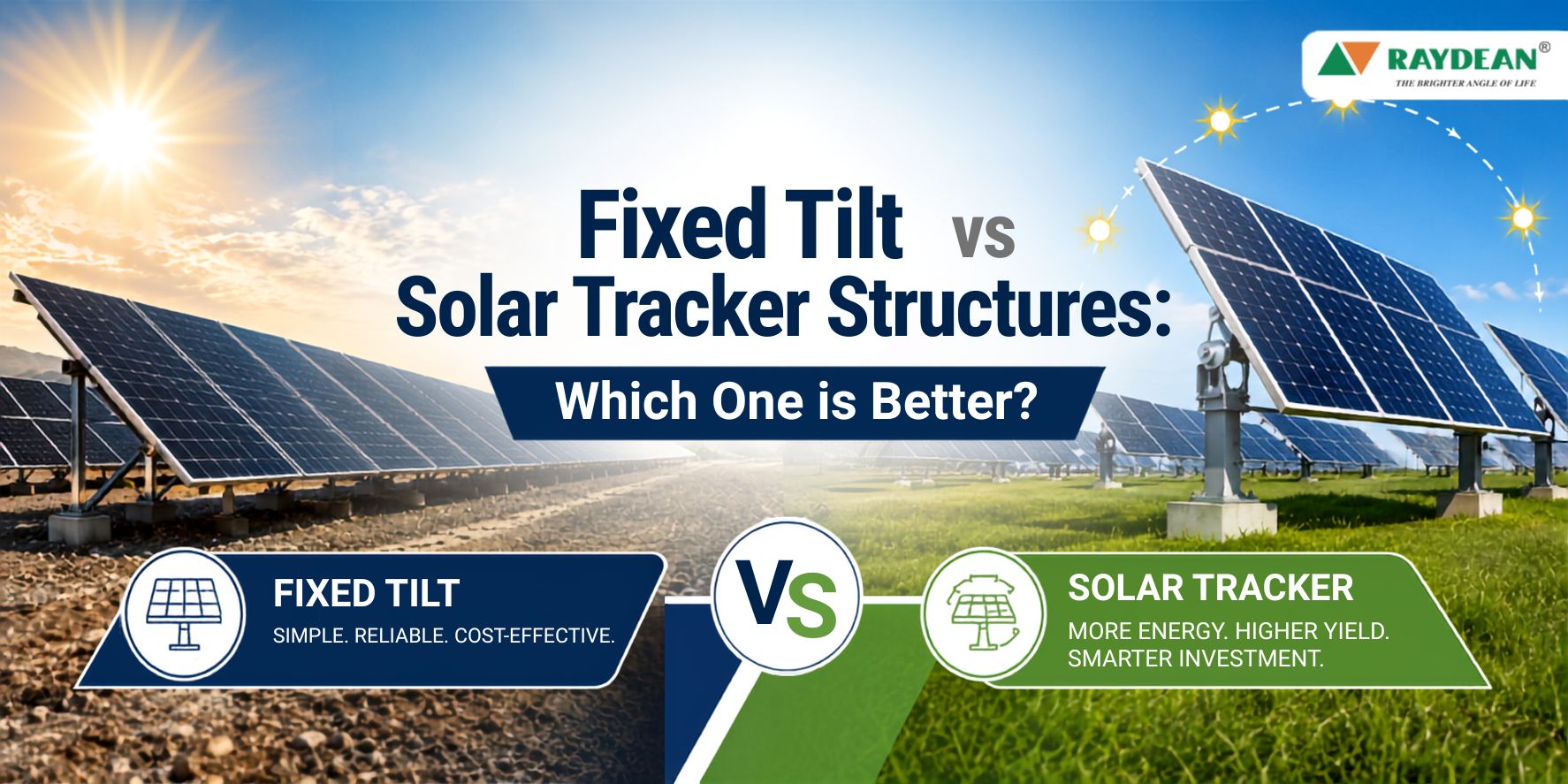
Fixed Tilt vs Solar Tracker Structures: Which One Is Better?
-

-

-

No Comments
Fixed Tilt vs Solar Tracker Structures: Which One Is Better?
Introduction
Choosing the right mounting system is one of the most important decisions when planning a solar power project. While solar modules receive most of the attention, the mounting structure determines how securely the panels are installed, how they are positioned toward the sun, and how reliably the system performs over its operating life.
A fixed tilt system keeps solar panels at a predetermined angle and orientation throughout the year. A solar tracker, on the other hand, changes the panel position during the day to follow the sun and increase solar irradiation received by the modules.
The answer depends on the project’s location, available land, energy-generation target, budget, terrain, operating conditions, maintenance capability, and expected return on investment. Fixed tilt is generally simpler, more economical, and easier to maintain, while trackers can provide higher energy yield when site conditions and project economics support their additional cost and complexity.
Quick Answer: Fixed Tilt vs Solar Tracker
Fixed tilt structures are usually better when low upfront cost, simplicity, reliability, and minimal maintenance are the priorities. Solar trackers can be better when maximizing energy generation per installed MW and available land is more important than minimizing system complexity.
Here is a quick comparison:
| Parameter | Fixed Tilt Structure | Solar Tracker Structure |
| Panel movement | No | Yes |
| Energy yield | Good | Generally higher |
| Initial cost | Lower | Higher |
| Moving parts | No | Yes |
| Maintenance | Low | Higher |
| Mechanical complexity | Low | High |
| Installation | Relatively simple | More complex |
| Land optimization | Good | Can be excellent depending on design |
| Reliability | Very high when properly designed | Depends on mechanical and control systems |
| Suitable projects | Rooftop, C&I and utility-scale | Primarily suitable for suitable ground-mounted projects |
| Best for | Cost-conscious projects | Yield-focused projects |
What Is a Fixed Tilt Solar Mounting Structure?
A fixed tilt solar mounting structure is a support system that holds photovoltaic modules at a predetermined tilt angle and orientation.
Once installed, the structure does not automatically move with the sun. The angle is selected during engineering based on factors such as:
- Project location and latitude
- Solar irradiation
- Module technology
- Row spacing
- Shading analysis
- Wind conditions
- Land availability
- Desired annual energy generation
- Foundation and soil conditions
Fixed tilt systems are widely used for ground-mounted solar plants, commercial and industrial projects, and rooftop applications.
For example, Raydean’s ground-mounted fixed tilt structures are designed to securely support PV modules at an optimized orientation, with options for fixed or adjustable configurations depending on project requirements.
How Fixed Tilt Structures Work
The structure normally consists of components such as:
- Vertical posts or columns
- Rails or purlins
- Bracing members
- Module clamps
- Fasteners
- Foundation or pile system
- Corrosion-protection coating
The modules are fixed to the structure at the engineered tilt angle. The system remains stationary while the sun moves across the sky.
Because there are no motors, controllers, or rotating mechanisms, the mechanical design is comparatively straightforward.
What Is a Solar Tracker Structure?
A solar tracker is a mounting system that changes the orientation of solar modules to follow the sun’s apparent movement.
The objective is simple: keep the solar panels better aligned with incoming sunlight for a greater portion of the day.
Solar trackers can generally be divided into:
Single-Axis Solar Trackers
A single-axis tracker rotates the solar array around one axis, typically following the sun from east to west during the day.
Single-axis tracking is commonly considered for utility-scale ground-mounted projects where additional energy yield can justify the extra equipment and operating complexity.
NREL’s PV modeling documentation distinguishes fixed arrays from one-axis tracking systems and notes that tracking systems rotate the array to follow the daily movement of the sun.
Dual-Axis Solar Trackers
Dual-axis trackers can move around two axes. This allows the array to adjust for both the sun’s daily movement and seasonal changes in solar position.
However, dual-axis systems generally involve greater mechanical complexity, higher costs, and more maintenance requirements than fixed tilt or single-axis systems.
For large solar power projects, the choice is therefore usually evaluated through detailed technical and financial analysis rather than simply selecting the system with the highest theoretical energy capture.
How Solar Mounting Structures Work
Whether a project uses fixed tilt or tracking technology, the primary purpose of a solar mounting structure is to provide a secure and engineered interface between the PV modules and the roof, ground, or foundation system.
A properly designed mounting system must:
- Support the weight of the PV modules.
- Maintain the required module orientation.
- Transfer structural loads safely to the foundation.
- Resist wind and other environmental loads.
- Maintain row alignment and module spacing.
- Reduce unnecessary movement or vibration.
- Provide adequate clearance for operation and maintenance.
- Protect against corrosion over the expected service life.
- Accommodate the selected module dimensions and installation method.
- Support safe and efficient installation.
For fixed systems, the structure maintains a constant position.
For tracker systems, the structure must also accommodate rotating components, drive mechanisms, bearings, controllers, and other tracker-specific components.
This makes engineering and quality control especially important for tracker-compatible structures
Fixed Tilt vs Solar Tracker: Detailed Comparison
1. Energy Generation
The biggest advantage of solar trackers is their ability to improve the alignment of PV modules with the sun during the day.
A fixed structure has one selected orientation and tilt. Consequently, the angle of sunlight changes throughout the day and across seasons.
A tracker actively changes the module position to follow solar movement.
However, higher energy yield does not automatically mean higher project profitability.
The actual gain depends on:
- Location
- Solar resource
- Tracker technology
- Module characteristics
- Backtracking strategy
- Row spacing
- Terrain
- Shading
- System availability
- Temperature
- Operation and maintenance practices
Therefore, energy-yield modeling should be performed for the specific project rather than assuming a universal percentage improvement.
2. Initial Investment
Fixed tilt systems generally have fewer components and no motorized tracking mechanism.
This can make them more economical to manufacture, transport, install, and commission.
Solar trackers require additional components such as:
- Motors
- Drives
- Bearings
- Controllers
- Torque tubes or rotating assemblies
- Communication systems
- Tracker-specific electrical components
As a result, the initial investment can be higher.
3. Maintenance Requirements
Fixed tilt structures have no moving mechanical parts.
Routine maintenance generally focuses on:
- Structural inspection
- Fastener checks
- Corrosion inspection
- Foundation inspection
- Module-clamp condition
- Structural alignment
Trackers add mechanical and electronic components that require inspection and maintenance.
Potential maintenance areas include:
- Motors and actuators
- Bearings
- Drive systems
- Controllers
- Sensors
- Communication systems
- Tracker alignment
- Mechanical connections
For projects where simple operation and low maintenance are priorities, fixed tilt can have a significant advantage.
4. Reliability
A well-engineered fixed tilt structure has a relatively simple mechanical configuration.
There are fewer components that can experience mechanical failure.
Trackers can be highly reliable when correctly engineered, installed, operated, and maintained, but their greater number of moving components introduces additional failure modes.
The quality of engineering, materials, installation, controls, and preventive maintenance therefore becomes particularly important.
5. Land Requirements
Land-use efficiency is more complicated than simply comparing fixed tilt and tracker layouts.
Trackers require sufficient row spacing and operating clearance to reduce shading and allow the arrays to move safely.
Backtracking can be used in some tracker systems to reduce row-to-row shading during certain periods.
The optimal layout depends on:
- Site dimensions
- Terrain
- Tracker geometry
- Module configuration
- Ground coverage ratio
- Shading analysis
- Access roads
- Drainage
- Maintenance pathways
NREL’s PV modeling resources account for ground coverage ratio and self-shading when modeling fixed and tracking arrays.
6. Installation Complexity
Fixed tilt structures are comparatively straightforward to install.
The structure is assembled, aligned, and fixed to the foundation before modules are installed.
Tracker projects require additional attention to mechanical alignment, drive components, wiring, controls, and commissioning.
This can increase installation complexity and require specialized technical expertise.
7. Suitability for Different Projects
Fixed tilt structures can be used across a broad range of solar applications, including:
- Utility-scale solar farms
- Commercial solar plants
- Industrial solar projects
- Ground-mounted systems
- Rooftop solar
- Agricultural applications
- Solar carports
- Smaller distributed-generation projects
Solar trackers are primarily suited to ground-mounted projects where the additional energy yield can justify the higher system complexity.
They are generally less attractive for conventional rooftop installations because roof geometry, structural limitations, maintenance access, and movement requirements can make tracking impractical.
Advantages of Fixed Tilt Solar Structures
Fixed tilt systems remain popular because they provide a strong combination of performance, simplicity, and cost efficiency.
Key advantages include:
- Lower initial investment
- Simple mechanical design
- No tracking motors
- Lower mechanical maintenance
- Easier installation
- Proven technology
- Straightforward structural inspection
- Flexible applications
- Easier integration with different project layouts
- Suitable for a wide range of Indian solar projects
A properly engineered fixed tilt structure can deliver reliable long-term performance without the additional mechanical complexity of a tracker.
For projects where the primary objective is a predictable and economical solar installation, fixed tilt is often the preferred choice.
Advantages of Solar Tracker Structures
Trackers are attractive when maximizing energy generation is a major project objective.
Major advantages include:
- Better solar alignment during the day
- Potentially higher annual energy generation
- Improved utilization of the available solar resource
- Potentially higher output from the same installed DC capacity
- Strong suitability for certain utility-scale projects
- Compatibility with modern large-format PV modules when appropriately engineered
However, these advantages must be evaluated against the additional capital expenditure, maintenance, land-layout considerations, and operational requirements.
Disadvantages of Fixed Tilt Structures
Fixed tilt systems also have limitations.
The main disadvantages are:
- Panels cannot actively follow the sun
- Lower energy capture during periods when the sun is far from the optimum fixed angle
- May require careful optimization of tilt and row spacing
- Additional land may sometimes be required to achieve a desired generation target compared with a high-yield tracking configuration
- Energy output depends strongly on the selected fixed orientation and tilt
These limitations do not make fixed tilt systems inferior. They simply mean the structure should be optimized for the specific project.
Disadvantages of Solar Tracker Structures
Trackers can deliver additional energy, but their benefits come with additional considerations.
Common challenges include:
- Higher upfront cost
- More mechanical components
- Greater maintenance requirements
- More complex installation
- Additional electrical and control components
- Potential downtime associated with mechanical or control-system issues
- Greater engineering requirements
- Site-specific terrain and shading constraints
- More complex operation and maintenance
The tracker should therefore be selected based on a complete lifecycle analysis rather than energy yield alone.
Fixed Tilt vs Tracker: Which Has Better ROI?
There is no universal answer.
The right financial comparison should consider levelized cost of electricity (LCOE), energy yield, CAPEX, O&M cost, financing, land cost, project lifetime, degradation, and system availability.
A tracker may generate more electricity but also cost more.
A fixed tilt system may produce less energy per installed MW but require less capital and maintenance.
A simple project evaluation can be structured as:
Additional Tracker Value = Additional Energy Revenue − Additional CAPEX − Additional O&M Costs
If the additional energy revenue sufficiently exceeds the extra lifecycle costs, the tracker may provide better financial returns.
If not, fixed tilt may be the better investment.
Which Structure Is Better for Indian Solar Projects?
India has diverse solar conditions, terrain, wind zones, land characteristics, and project economics. Therefore, the best mounting structure should be selected according to the project’s actual site conditions.
For example, a utility-scale solar project with suitable terrain, strong solar irradiation, sufficient land, and a focus on maximizing generation may justify a tracker.
On the other hand, a commercial or industrial project focused on predictable costs, simple maintenance, and reliable structural performance may benefit from fixed tilt.
Engineering should consider site-specific wind loading, foundation conditions, module dimensions, corrosion environment, row spacing, shading, and applicable design requirements.
Government and project specifications can also define requirements for module mounting structures. For example, MNRE project documentation includes requirements relating to module inclination, shading, weather resistance, and structural design.
How to Choose the Right Solar Mounting Structure
Before selecting fixed tilt or tracker technology, consider the following factors.
1. Project Capacity
Small and medium projects may favor simplicity and cost control, while larger utility-scale projects can justify detailed tracker feasibility studies.
2. Location and Solar Resource
Solar irradiation and the sun’s path affect the potential benefit of tracking.
3. Land Availability
If land is limited or expensive, the optimal layout and energy yield per hectare become important financial considerations.
4. Wind Conditions
The structure must be engineered for the project’s wind conditions. Wind loading can significantly influence structural members, foundations, module clamps, and tracker design.
5. Soil and Foundation Conditions
Ground-mounted systems depend heavily on soil conditions. Pile selection, foundation depth, corrosion considerations, and installation methods should be evaluated before finalizing the structure.
6. Maintenance Capability
Projects with limited access to specialized maintenance teams may prefer simpler fixed structures.
7. Project Financial Model
Compare total lifecycle economics rather than only the initial structure price.
8. Module Technology
Modern high-power and bifacial modules can influence structure configuration, row spacing, loading, and overall project design.
9. Corrosion Protection
Solar structures operate outdoors for decades. Material selection and corrosion protection are therefore critical to long-term structural performance.
10. Supplier’s Engineering Capability
A reliable Solar Mounting Structure Supplier in India should be able to understand project drawings, loading conditions, module specifications, foundations, corrosion requirements, and installation constraints.
Why Choosing the Right Solar Structure Manufacturer Matters
The mounting structure is not simply a collection of steel components. It is a critical part of the balance-of-system infrastructure.
When evaluating a Solar Structure Manufacturer in India, consider:
- Manufacturing capacity
- Engineering capabilities
- Material traceability
- Structural design expertise
- Galvanization and corrosion protection
- Quality-control procedures
- Testing and inspection
- Production consistency
- Project experience
- Installation support
- Ability to meet project timelines
For large-scale projects, the manufacturer’s ability to maintain dimensional accuracy and consistent quality across thousands of structural components is particularly important.
Raydean provides fixed tilt systems and solar trackers for commercial and utility solar applications, along with galvanized steel structures and corrosion-protection solutions.
Why Work With a Solar Structure Manufacturer in Rajasthan?
Rajasthan is one of India’s most important regions for solar development, with extensive land availability and strong solar resources in many areas.
For projects in the state, working with a Solar Structure Manufacturer in Rajasthan can provide practical advantages such as:
- Better regional project understanding
- Efficient logistics for Rajasthan projects
- Faster coordination with EPC contractors
- Understanding of local environmental conditions
- Site-specific structural engineering
- Support for large utility-scale requirements
A manufacturer located in the region can also be well positioned to support projects across Jaipur and other parts of Rajasthan.
Choosing a Solar Structure Manufacturer in Jaipur
For developers and EPC companies looking for a Solar Structure Manufacturer in Jaipur, engineering quality and manufacturing capability should remain the primary selection criteria.
A suitable supplier should be able to provide:
- Fixed tilt structures
- Tracker-compatible structures where required
- Rooftop mounting systems
- Ground-mounted systems
- Customized structural solutions
- Galvanized steel components
- Project-specific engineering
- Consistent quality control
Raydean Enterprises is based in Jaipur, Rajasthan, and specializes in solar module mounting structures along with other infrastructure products.
Fixed Tilt vs Solar Tracker: Decision Guide
Use this simple decision framework:
Choose Fixed Tilt If:
- Your priority is lower CAPEX.
- You want a simple and reliable structure.
- Low mechanical maintenance is important.
- The project has sufficient land.
- The project economics do not justify tracking.
- You need a versatile mounting solution.
- You want a straightforward installation and O&M process.
Consider a Solar Tracker If:
- Maximizing energy generation is a major objective.
- The site is suitable for tracking.
- Additional CAPEX can be justified.
- The project has sufficient technical O&M capabilities.
- A detailed energy model demonstrates attractive returns.
- Land and layout conditions support tracker operation.
- The additional lifecycle value exceeds the additional cost.
Fixed Tilt vs Solar Tracker: Final Comparison
| Factor | Fixed Tilt | Solar Tracker |
| Capital cost | Lower | Higher |
| Energy yield | Good | Generally higher |
| Mechanical complexity | Low | High |
| Moving parts | None | Multiple |
| Maintenance | Low | Moderate to high |
| Installation | Easier | More complex |
| Structural simplicity | Excellent | Moderate |
| Rooftop suitability | Excellent | Generally limited |
| Utility-scale suitability | Excellent | Excellent where justified |
| O&M requirements | Lower | Higher |
| Best use case | Reliable, economical projects | Yield-focused projects |
Frequently Asked Questions
1. Is fixed tilt better than a solar tracker?
Fixed tilt is better when lower cost, simple installation, reliability, and low maintenance are the main priorities. A solar tracker may be better when maximizing energy generation and project revenue is more important and the additional cost can be justified.
2. Do solar trackers generate more electricity than fixed tilt systems?
Solar trackers can generate more electricity because they adjust the PV modules toward the sun. However, the actual energy gain depends on location, tracker design, module technology, shading, weather, system availability, and project layout.
3. Are solar trackers more expensive than fixed tilt structures?
Generally, yes. Trackers require additional mechanical, electrical, and control components, which can increase both initial investment and maintenance requirements compared with conventional fixed tilt structures.
4. Which solar mounting structure is best for India?
There is no single best structure for every Indian solar project. Fixed tilt is often attractive for its simplicity and cost efficiency, while trackers can be suitable for selected utility-scale projects where additional energy yield provides a strong financial return.
5. How do I choose a reliable solar mounting structure supplier in India?
Evaluate the supplier’s engineering expertise, manufacturing capacity, material quality, corrosion protection, structural design capability, quality-control process, project experience, delivery capability, and ability to customize the system for your site and module requirements.
Conclusion: Fixed Tilt or Solar Tracker?
Fixed tilt structures are generally the better choice for projects that prioritize lower CAPEX, simple installation, reliability, and low maintenance. Solar trackers can be the better choice for suitable utility-scale projects where additional energy generation can justify higher investment and operational complexity.
As a Solar Structure Manufacturer in Rajasthan and Solar Structure Manufacturer in Jaipur, Raydean can support solar projects with engineered mounting solutions for different applications and project requirements.
If you are planning a ground-mounted solar plant, commercial installation, utility-scale project, or another solar application, selecting the right mounting structure at the design stage can make a significant difference to long-term project performance.
Looking for a reliable solar mounting solution? Contact Raydean to discuss your project requirements and determine whether a fixed tilt or tracking structure is the right fit for your site.
To Know More: How to Choose the Best Solar Mounting Structure for Commercial Projects
Categories
- All (15)
- HDG Structure (1)
- Pre Galvanized Structure (1)
- Rooftop Solar Structure (2)
- Solar Mounting Structure (7)
- Transmission Towers (2)
- Telecom Tower (2)
- EPC (2)
- PM Surya Ghar Yojhna (1)