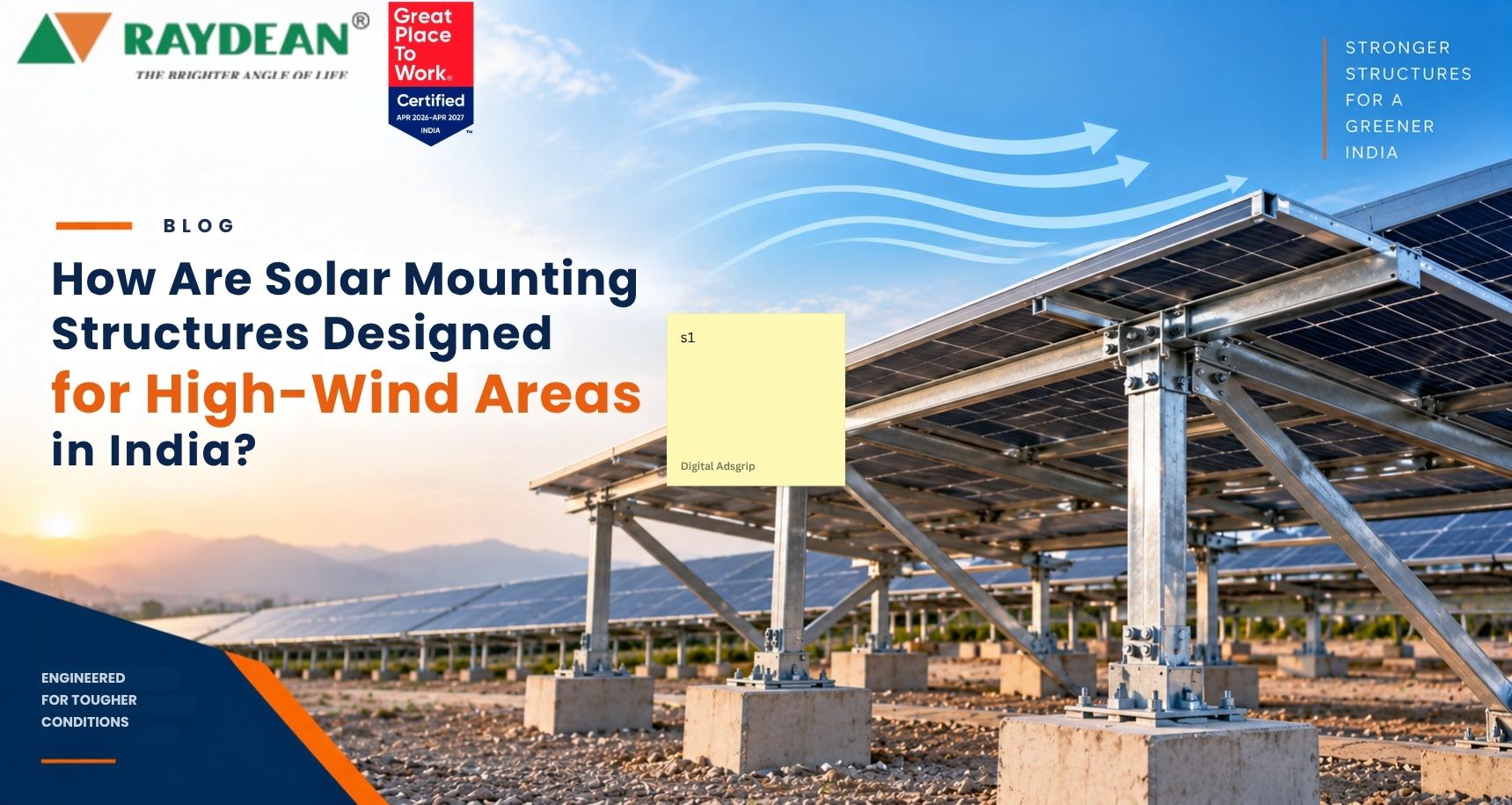
How Are Solar Mounting Structures Designed for High-Wind Areas in India
-

-

-

No Comments
How Are Solar Mounting Structures Designed for High-Wind Areas in India
India’s growing solar energy sector has created a greater need for durable and wind-resistant solar mounting systems. From Rajasthan’s desert regions to India’s coastal belts, solar installations must withstand strong winds, seasonal storms, and changing weather conditions. A well-engineered mounting structure protects solar panels, improves system stability, and supports long-term energy generation.
But how are solar mounting structures designed for high-wind areas in India? The process involves wind-load calculations, structural engineering, material selection, foundation design, and compliance with applicable Indian standards. Choosing the right design is essential for residential rooftops, commercial buildings, industrial facilities, and large-scale solar power plants.
Why Is Wind Resistance Important for Solar Mounting Structures?
Solar panels are exposed to wind throughout their operational life. During strong gusts, wind creates pressure on the panel surface and uplift forces that can pull panels and supporting components away from their mounting points.
Poorly designed structures may experience excessive vibration, loose fasteners, bending, or even structural failure.
Wind-resistant solar mounting systems help to:
- Improve the stability and safety of solar installations.
- Reduce the risk of panel displacement and structural damage.
- Protect rooftops, foundations, and supporting components.
- Minimise maintenance requirements and unexpected repair costs.
- Support reliable solar power generation over the system’s service life.
For these reasons, selecting the Best Solar Mounting Structures requires more than comparing prices. The structure must be engineered for the project’s location, wind exposure, roof conditions, and installation requirements.
How Are Solar Mounting Structures Designed for High-Wind Areas?
1. Wind-Load Analysis Based on Project Location
The first step is determining the design wind speed for the installation site. India has different wind zones, so a structure suitable for an inland location may not be appropriate for a coastal or cyclone-prone region.
Engineers consider factors such as:
- Basic wind speed specified for the location.
- Building height and surrounding terrain.
- Exposure to open fields, coastal winds, or nearby buildings.
- Roof edges, corners, and other areas exposed to higher wind pressure.
- Local topography and applicable design requirements.
Structural calculations should follow the relevant provisions of IS 875 (Part 3), which addresses wind loads on buildings and structures, using the applicable edition and project requirements.
2. Aerodynamic Design and Panel Tilt Angle
The angle and positioning of solar panels significantly influence wind forces. Steeper panel angles can increase wind exposure, while roof edges and corners may experience higher local pressures and suction.
Engineers assess panel tilt, row spacing, mounting height, orientation, and edge clearances to develop an appropriate configuration.
For rooftop installations, low-profile mounting systems may help reduce wind exposure when compatible with drainage, ventilation, and energy-generation requirements. For ground-mounted projects, carefully planned row spacing and orientation can help manage aerodynamic effects.
The objective is not simply to minimise the panel angle. It is to achieve a safe balance between wind resistance, solar performance, and structural requirements.
3. Strong Materials and Structural Components
Material quality plays a major role in the strength and durability of solar mounting systems. Galvanised steel is widely used because of its strength and protective zinc coating. Aluminium may also be suitable for certain applications, depending on loading, corrosion exposure, and design requirements.
A reliable Solar Structure Manufacturer in India should consider:
- Steel grade and section thickness.
- Member dimensions and connection details.
- Corrosion protection and coating quality.
- Fastener strength and compatibility.
- Resistance to bending, buckling, and fatigue.
- Long-term durability under local environmental conditions.
A qualified Solar Structure Manufacturer in Jaipur should also account for Rajasthan’s local climate, including heat, dust, and seasonal wind conditions, when designing and specifying materials.
4. Secure Connections and Fixing Systems
Even a strong steel frame can fail if its connections are inadequately designed. High-wind installations require properly engineered connections between solar modules, rails, purlins, columns, bracing, and foundations.
Depending on the project, engineers may specify appropriately sized bolts, clamps, anchor bolts, welds, and reinforced connection plates.
Connection design should account for wind uplift, shear forces, and bending moments. Installation teams must follow approved drawings and the specified tightening and fabrication procedures.
For rooftop systems, the fixing arrangement must also be compatible with the existing building structure. Simply attaching a mounting frame to a roof sheet without verifying the load path can create serious risks.
5. Foundation Design for Ground-Mounted Solar Projects
Ground-mounted solar installations need foundations capable of transferring wind forces safely into the soil. Depending on site conditions, engineers may select driven piles, concrete foundations, ground screws, or other engineered solutions.
Foundation design considers:
- Soil bearing capacity and geotechnical conditions.
- Wind-induced uplift and lateral forces.
- Overturning moments and sliding resistance.
- Embedment depth and foundation dimensions.
- Groundwater, drainage, and corrosion conditions.
The most suitable option depends on the site’s soil investigation and structural calculations. This is particularly important when selecting the best ground-mounted solar structures for large solar farms and open, wind-exposed locations.
6. Structural Testing, Quality Control, and Compliance
Before installation, the design should be checked against applicable structural requirements and project specifications. Depending on the system and project risk, verification may include engineering calculations, connection checks, material inspection, fabrication quality checks, and physical testing where appropriate.
A dependable Solar Structure Supplier should provide clear technical specifications, traceable material information, fabrication quality documentation, and installation drawings.
Projects involving multiple infrastructure components may also benefit from working with an experienced EPC Steel Structure Manufacturer or EPC Infrastructure Manufacturer that understands structural coordination, fabrication, and site execution.
Rooftop vs Ground-Mounted Solar Structures in High-Wind Areas
| Design factor | Rooftop solar structures | Ground-mounted solar structures |
| Main concern | Wind uplift and roof capacity | Wind pressure, overturning, and foundation stability |
| Key design consideration | Roof fixings and load transfer | Soil conditions, pile depth, and bracing |
| Typical materials | Galvanised steel or aluminium | Commonly galvanised steel |
| Site assessment | Existing roof and supporting members | Geotechnical conditions and terrain |
| Wind-control approach | Suitable profile, tilt, and secure anchoring | Engineered geometry, spacing, bracing, and foundations |
Both systems require location-specific engineering. Neither mounting type is automatically safer in high winds without proper design and installation.
How to Choose the Right Solar Mounting Structure Manufacturer in India
Choosing a reliable manufacturer is essential for project safety and long-term performance. Before finalising a supplier, evaluate the following:
- Engineering capability: Can the manufacturer provide wind-load calculations and project-specific structural drawings?
- Material quality: Are steel grades, section dimensions, and corrosion-protection specifications documented?
- Manufacturing standards: Are fabrication processes and quality checks clearly defined?
- Installation compatibility: Are the mounting system and fixing details suitable for the actual site?
- Project experience: Has the manufacturer handled similar rooftop or ground-mounted installations?
- Technical support: Can the team coordinate with installers, consultants, and EPC contractors?
The best solar mounting structure for rooftop applications is one that suits the roof type, building capacity, wind exposure, and installation method. Similarly, ground-mounted projects need structures engineered for the site’s soil, terrain, and wind conditions rather than relying on a standard design for every location.
Conclusion: Invest in Wind-Resistant Solar Mounting Structures
Designing solar mounting structures for high-wind areas in India requires accurate wind-load assessment, suitable materials, secure connections, stable foundations, and strict quality control. Every project must be evaluated according to its location, installation type, and applicable engineering standards.
Raydean can be considered for project discussions involving solar mounting solutions and structural requirements. Before choosing a system, request the relevant technical specifications and confirm that the proposed design is suitable for your site’s wind conditions.
Planning a rooftop or ground-mounted solar project? Contact Raydean to discuss your solar mounting structure requirements and explore a solution designed around your project’s engineering needs.
Frequently Asked Questions (FAQs)
1. How are solar mounting structures protected against high winds in India?
They are designed using location-specific wind-load calculations, suitable structural sections, secure connections, appropriate panel positioning, and engineered foundations or roof fixings. Designs should comply with applicable Indian standards and project requirements.
2. Which solar mounting structure is best for high-wind areas?
The best option depends on the site, wind exposure, roof or soil conditions, panel configuration, and installation type. A project-specific engineered structure is generally preferable to a generic mounting system.
3. Which Indian standard is used for calculating wind loads on solar mounting structures?
IS 875 (Part 3) provides provisions for calculating wind loads on buildings and structures in India. Engineers should use the applicable edition and account for the project’s specific structural requirements.
4. Are galvanised steel solar mounting structures suitable for high-wind regions?
Yes. Properly specified galvanised steel structures can offer high strength and corrosion protection. Their suitability depends on structural calculations, section dimensions, connection design, coating quality, and environmental exposure.
5. How can I choose a reliable solar structure manufacturer in India?
Look for a manufacturer with proven engineering capabilities, documented material specifications, quality-controlled fabrication, project-specific drawings, and technical support. Confirm that the proposed structure is designed for the site’s wind loads and installation conditions.
To Know More: How Rooftop Solar Mounting Structures Support PM Surya Ghar Installations
Categories
- All (15)
- HDG Structure (1)
- Pre Galvanized Structure (1)
- Rooftop Solar Structure (2)
- Solar Mounting Structure (7)
- Transmission Towers (2)
- Telecom Tower (2)
- EPC (2)
- PM Surya Ghar Yojhna (1)