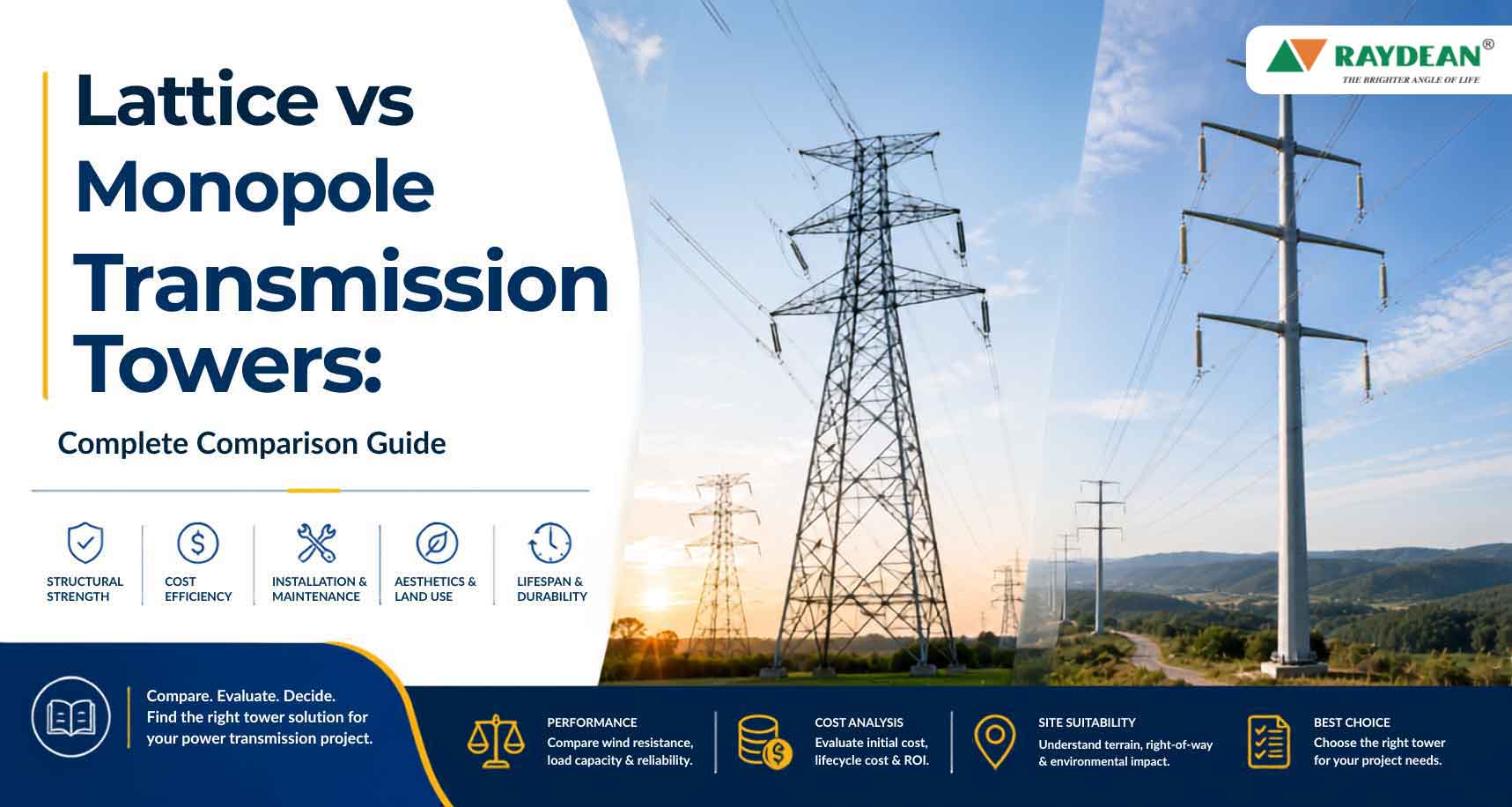
Lattice vs Monopole Transmission Towers: Complete Comparison Guide
-

-

-

No Comments
Lattice vs Monopole Transmission Towers: Complete Comparison Guide
Transmission towers are one of the most critical components of modern electrical infrastructure. They support conductors, maintain required electrical clearances, withstand environmental loads, and enable electricity to travel safely across long distances. When planning a transmission line, one of the most important decisions is selecting the appropriate tower configuration. Two widely used options are lattice transmission towers and Monopole Transmission Towers. The answer depends on several factors, including voltage level, right-of-way availability, terrain, wind conditions, structural requirements, foundation conditions, installation constraints, aesthetics, and overall project economics.
This lattice vs monopole transmission towers comparison explains the key differences between both structures, their advantages and limitations, typical applications, cost considerations, and the factors project developers should evaluate before making a decision.
What Are Transmission Towers?
Transmission towers are structural systems used to support overhead electrical conductors and associated equipment along transmission lines. They maintain the necessary separation between conductors, the ground, structures, and other electrical infrastructure.
Transmission towers can be designed in different configurations depending on the transmission voltage, circuit arrangement, span length, terrain, loading conditions, and available corridor.
Common tower types include:
- Lattice towers
- Monopole towers
- Guyed towers
- Special towers for river crossings and other challenging locations
In India, tower selection and transmission-line design must consider applicable Central Electricity Authority requirements and relevant Indian Standards. Current CEA planning guidance also recognizes pole-type structures and narrow-base towers as options for optimizing right-of-way, particularly in semi-urban and urban areas.
What Is a Lattice Transmission Tower?
A lattice transmission tower is an open-frame steel structure made from interconnected structural members. The members form a triangulated framework that provides high structural efficiency while keeping the overall weight relatively low for the loads carried.
Lattice towers are commonly associated with long-distance and high-voltage transmission networks because their geometry can be adapted to different loading requirements, conductor arrangements, and circuit configurations.
They can be engineered as:
- Single-circuit towers
- Double-circuit towers
- Multi-circuit towers
- Suspension towers
- Tension or angle towers
- Terminal or dead-end towers
- Special-purpose structures
Lattice designs can also be customized for different heights, spans, conductor configurations, and site conditions.
What Are Monopole Transmission Towers?
A monopole transmission tower is a single-column steel structure used to support overhead transmission conductors and associated equipment.
Unlike a lattice tower, which consists of multiple interconnected steel members, a monopole generally has a compact vertical profile. Its smaller footprint makes it particularly useful where land availability and right-of-way constraints are major considerations.
Monopoles may be manufactured as tapered tubular structures or other engineered pole configurations, depending on project requirements.
They are often considered for:
- Urban and semi-urban transmission corridors
- Space-constrained sites
- Roadside transmission routes
- Locations where a compact foundation footprint is desirable
- Projects where visual impact needs to be minimized
- Selected high-voltage applications where engineering requirements permit
CEA guidance specifically notes the use of pole-type towers in semi-urban and urban areas as one approach to right-of-way optimization.
Lattice vs Monopole Transmission Towers: Key Differences
The biggest difference between lattice and monopole towers is their structural configuration.
| Factor | Lattice Transmission Tower | Monopole Transmission Tower |
| Structural form | Open steel framework | Single-column steel structure |
| Footprint | Generally larger | Generally more compact |
| Right-of-way | Requires more corridor space in many applications | Suitable where space is constrained |
| Installation | Multiple structural members assembled on site | Faster erection possible with fewer major components |
| Maintenance | Multiple members and connections require inspection | Simpler external structural form |
| Visual appearance | More prominent open-frame structure | Slimmer and cleaner profile |
| Multi-circuit flexibility | Highly adaptable | Depends on engineered configuration |
| Long-span applications | Very suitable | Application-dependent |
| Urban suitability | Can be challenging where space is limited | Often advantageous |
| Foundation | Varies with loading and soil conditions | Can require concentrated foundation design |
| Typical application | Long-distance and high-voltage networks | Space-constrained and selected transmission corridors |
Lattice Transmission Towers: Advantages and Limitations
Advantages of Lattice Towers
1. High Structural Efficiency
The triangulated configuration of a lattice tower provides an efficient way to transfer loads through the structure.
This makes lattice designs suitable for demanding transmission applications involving significant conductor, wind, equipment, and structural loads.
2. Flexible Design
Lattice towers can be engineered in different configurations to accommodate:
- Different voltage levels
- Single or multiple circuits
- Different conductor arrangements
- Various tower heights
- Different line angles
- Special loading conditions
This flexibility makes them a proven option for large transmission networks.
3. Suitable for Long-Distance Transmission
Lattice towers are widely suited to long transmission corridors where land availability is less restrictive and structural requirements are substantial.
They can also be designed for special applications such as long-span crossings when appropriate engineering and loading criteria are applied.
4. Multi-Circuit Capability
A major advantage of lattice structures is their ability to accommodate complex conductor arrangements.
For projects requiring multiple circuits or specialized phase configurations, lattice towers can provide substantial design flexibility.
5. Established Engineering Practices
Lattice transmission tower design is supported by well-established engineering methodologies, testing practices, fabrication processes, and erection techniques.
Limitations of Lattice Towers
Despite their advantages, lattice towers may not be ideal for every site.
Potential limitations include:
- Larger overall footprint
- Greater visual presence
- More individual structural members
- More bolted connections to inspect
- Potentially greater site assembly requirements
- Challenges in densely populated corridors
For projects with severe right-of-way restrictions, a monopole may offer a more practical alternative.
Monopole Transmission Towers: Advantages and Limitations
Advantages of Monopole Towers
1. Compact Footprint
One of the strongest advantages of monopoles is their compact structural footprint.
This can be particularly valuable in:
- Urban areas
- Industrial zones
- Roadside corridors
- Congested infrastructure corridors
- Areas with expensive or restricted land availability
2. Right-of-Way Optimization
Transmission corridors can become difficult and expensive to acquire in developed areas.
A compact pole structure can help reduce the physical space required for the tower installation, subject to the complete electrical clearance and corridor requirements of the project.
CEA planning guidance identifies pole-type structures as an option for optimizing right-of-way utilization in semi-urban and urban areas.
3. Cleaner Visual Profile
A monopole generally has a slimmer appearance than a conventional lattice tower.
This can make it attractive for locations where the visual impact of transmission infrastructure is an important consideration.
4. Faster Erection Potential
Because a monopole has fewer major structural components than a conventional lattice tower, site erection can potentially be faster.
Actual installation time depends on:
- Tower height
- Pole section design
- Foundation readiness
- Crane availability
- Site accessibility
- Weather
- Conductor configuration
5. Suitable for Space-Constrained Projects
Where acquiring additional land is difficult, a monopole can provide a practical structural solution if the required electrical, structural, and clearance criteria can be satisfied.
Limitations of Monopole Towers
Monopoles also have limitations.
These can include:
- Concentrated foundation loads
- More demanding foundation design in some soil conditions
- Transportation considerations for large pole sections
- Design limitations depending on circuit arrangement
- Specialized engineering requirements for higher loads and heights
- Potentially higher material or fabrication costs in certain applications
Therefore, a monopole should not be selected simply because it occupies less visible space. Structural and electrical engineering requirements must remain the primary considerations.
Lattice vs Monopole Transmission Towers: Cost Comparison
Cost is one of the most important factors when selecting a transmission tower.
However, comparing only the purchase price of the tower can lead to an inaccurate conclusion.
The total project cost can include:
- Tower material
- Engineering and design
- Fabrication
- Galvanization
- Transportation
- Foundation
- Erection
- Right-of-way acquisition
- Land preparation
- Maintenance
- Inspection
- Future modification requirements
Lattice Tower Cost
Lattice towers can be economically attractive for large-scale transmission projects because they use an efficient structural framework and have established manufacturing and erection processes.
However, their overall project cost can increase when land availability is limited or when difficult access and extensive foundation work are involved.
Monopole Tower Cost
A monopole can provide economic benefits where its compact footprint reduces land and corridor challenges.
However, its manufacturing, transportation, connection details, and foundation requirements can vary significantly according to tower height and loading.
Lattice vs Monopole: Foundation Requirements
Foundation design is another major consideration.
The foundation must safely transfer structural loads into the soil while maintaining stability under different loading conditions.
Lattice Tower Foundations
Lattice towers distribute loads through multiple tower legs. Depending on soil parameters, tower type, loading, and site conditions, foundations can include different configurations such as:
- Open foundations
- Pile foundations
- Raft-type foundations
- Other engineered foundation solutions
Monopole Tower Foundations
A monopole transfers substantial loads through a concentrated foundation system.
Depending on the soil and structural requirements, monopoles may require:
- Reinforced concrete foundations
- Deep foundations
- Specialized anchor or connection arrangements
- Engineered foundation systems for overturning and moment loads
Foundation selection should always be based on geotechnical investigation and structural calculations rather than tower type alone.
Lattice vs Monopole: Installation and Maintenance
Installation
Lattice towers typically arrive as multiple fabricated and galvanized components that are assembled and erected at the project site.
Monopoles generally use larger pre-engineered sections that are assembled and lifted into position.
The actual installation strategy depends on:
- Site accessibility
- Crane capacity
- Tower dimensions
- Foundation construction
- Transportation logistics
- Terrain
- Weather conditions
Maintenance
Both tower types require periodic inspection and maintenance.
For lattice structures, inspections may focus on:
- Bolted connections
- Structural members
- Corrosion
- Galvanization
- Foundation condition
- Earthing
- Conductor and hardware interfaces
For monopoles, inspections may include:
- Pole sections
- Flanges or connections
- Welded areas where applicable
- Corrosion protection
- Foundation condition
- Earthing
- Conductor support arrangements
Proper galvanization and quality manufacturing can significantly improve the service life of transmission structures.
Which Tower Is Better for High-Voltage Transmission?
For high-voltage applications, tower selection depends on the complete engineering requirements rather than simply choosing between lattice and monopole.
Important considerations include:
- Voltage level
- Number of circuits
- Conductor type
- Phase arrangement
- Required electrical clearances
- Wind loading
- Seismic conditions
- Tower height
- Span length
- Terrain
- Right-of-way
- Foundation conditions
- Reliability requirements
Indian transmission projects must comply with applicable CEA requirements and relevant standards. Current technical requirements reference standards such as IS 802 for tower design, while project specifications can also establish additional loading and reliability criteria.
For certain projects, lattice towers remain the preferred solution because of their structural flexibility. For selected urban or space-constrained applications, pole-type structures may provide a more suitable alternative.
How to Choose Between Lattice and Monopole Towers
Before selecting a tower configuration, project developers should evaluate the following factors.
1. Available Right-of-Way
If the corridor is wide and land availability is not a major issue, lattice towers can be highly practical.
If the corridor is narrow or located in a developed area, a monopole may deserve consideration.
2. Voltage Level
Higher voltage generally creates more demanding electrical clearance and structural requirements.
The tower configuration must therefore be selected according to the complete line design.
3. Circuit Requirements
Determine whether the project requires:
- Single circuit
- Double circuit
- Multi-circuit
- Future circuit expansion
This can strongly influence the structural configuration.
4. Terrain and Soil
A tower that works well in one location may not be suitable in another.
Consider:
- Soil bearing capacity
- Groundwater conditions
- Rocky terrain
- Flood-prone areas
- Sloping land
- Seismic conditions
- Accessibility
5. Wind and Environmental Loads
Wind loading can significantly affect tower design.
The project should consider applicable wind zones, local wind conditions, terrain exposure, and other environmental factors.
Current Indian transmission specifications require appropriate consideration of wind conditions and allow additional loading criteria where necessary to improve line reliability.
6. Installation Logistics
Consider whether heavy equipment can reach the site and whether large tower components can be transported safely.
Urban and congested locations may place greater importance on installation planning.
7. Long-Term Economics
Evaluate the entire lifecycle rather than the initial tower price.
A good evaluation considers:
Tower + Foundation + Transportation + Erection + Land/ROW + Maintenance = Total Project Cost
When Should You Choose a Lattice Transmission Tower?
A lattice tower may be the preferred option when:
- Long-distance transmission is required
- Multiple circuits need to be supported
- High structural flexibility is important
- Large spans are required
- Land availability is relatively favorable
- A conventional transmission corridor is available
- Proven lattice tower configurations are preferred
When Should You Choose a Monopole Transmission Tower?
A monopole may be preferable when:
- Right-of-way is limited
- The project is located in an urban or semi-urban area
- A compact footprint is important
- Visual impact needs to be reduced
- Construction access is restricted
- The project can accommodate the required monopole foundation
- The electrical and structural requirements are compatible with a pole-type design
Transmission Towers in India: Why Local Manufacturing Matters
India has a large and continuously developing transmission infrastructure network connecting generating stations, substations, industrial centers, renewable-energy projects, and growing urban areas.
For project owners and EPC contractors, selecting an experienced transmission tower manufacturer in India can provide advantages in areas such as:
- Engineering support
- Local manufacturing
- Material sourcing
- Quality control
- Galvanization
- Transportation planning
- Project coordination
- Customized tower fabrication
A reliable transmission line tower manufacturer India should have the manufacturing capabilities, engineering expertise, quality systems, and production infrastructure required for the project’s specifications. For high-voltage projects, choosing a capable high voltage transmission tower manufacturer India is especially important because tower design and manufacturing must satisfy demanding structural, electrical, and environmental requirements.
Electrical Transmission Towers in India: Key Selection Factors
When selecting electrical transmission towers in India, project teams should look beyond the basic tower configuration.
The evaluation should include:
- Applicable standards and regulations
- Voltage level
- Circuit configuration
- Design wind speed and environmental loads
- Tower height
- Span requirements
- Electrical clearances
- Soil and foundation conditions
- Right-of-way availability
- Transportation and erection requirements
- Corrosion protection
- Quality assurance and testing
- Lifecycle cost
- Supplier manufacturing capacity
The Central Electricity Authority publishes transmission planning criteria and technical requirements that provide important guidance for Indian transmission infrastructure.
Transmission Towers in Rajasthan: Important Considerations
Projects involving transmission towers in Rajasthan can involve diverse site conditions, including arid environments, high temperatures, strong winds, open terrain, industrial corridors, and rapidly developing renewable-energy zones.
For such projects, tower selection should consider:
- Local wind conditions
- Soil characteristics
- Temperature variations
- Corrosion exposure
- Foundation requirements
- Long-distance transmission needs
- Renewable-energy evacuation requirements
- Accessibility to remote project sites
- Right-of-way availability
A transmission structure designed for Rajasthan should therefore be engineered around the actual site conditions rather than using a generic tower configuration.
Why Choose Raydean for Transmission Tower Structures?
Raydean provides custom-engineered transmission tower structures for different transmission applications.The company’s transmission tower portfolio includes lattice, monopole, and guyed structures, with designs intended for urban, rural, industrial, and renewable-energy applications. Raydean states that its transmission structures use high-strength galvanized steel and can be designed for different circuit configurations and demanding environmental conditions.
Raydean’s published transmission-line capabilities include compact monopoles and taller lattice structures for long-span applications. Its transmission structures are also described as suitable for multi-circuit lines, renewable-energy evacuation, and interstate transmission applications.
The company’s infrastructure includes a large-scale manufacturing and galvanizing setup, supporting fabrication and corrosion-protection requirements for transmission structures.
For project developers, EPC companies, utilities, and infrastructure contractors, the key advantage is the ability to evaluate tower selection according to the project’s actual technical and site requirements.
Frequently Asked Questions
1. What is the difference between lattice and monopole transmission towers?
The primary difference is their structural configuration. A lattice tower uses an open framework of interconnected steel members, while a monopole uses a single primary steel column. Lattice towers generally provide high design flexibility, while monopoles offer a compact footprint that can be advantageous in space-constrained areas.
2. Are monopole transmission towers better than lattice towers?
Not necessarily. The better option depends on the project’s voltage, circuit configuration, span, wind loading, soil, right-of-way, installation conditions, and cost. Monopoles can be advantageous in urban and space-constrained corridors, while lattice towers can be highly suitable for long-distance and multi-circuit transmission projects.
3. Which transmission tower is more cost-effective?
There is no universal answer. Lattice towers can be economical for conventional large-scale transmission lines, while monopoles may provide better overall project economics where land and right-of-way are expensive or restricted. The total installed lifecycle cost should be compared before making a decision.
4. Are monopole towers suitable for high-voltage transmission?
Yes, pole-type structures can be considered for suitable high-voltage applications when the structural, electrical, clearance, loading, foundation, and applicable regulatory requirements are satisfied. The final configuration should be determined through project-specific engineering.
5. How do I choose a transmission tower manufacturer in India?
Evaluate the manufacturer’s engineering capabilities, fabrication capacity, galvanizing facilities, quality systems, testing experience, applicable standards, project experience, customization capabilities, and ability to support transportation and erection requirements. For high-voltage projects, technical capability and quality assurance should be given particular importance.
Conclusion
The choice between lattice vs monopole transmission towers is not simply a matter of deciding which tower is stronger or cheaper. A lattice tower can provide excellent structural flexibility, multi-circuit capability, and suitability for long-distance transmission networks. A monopole can offer a compact footprint, reduced visual presence, and potential advantages where right-of-way and land availability are major constraints. Raydean offers custom-engineered transmission tower structures, including lattice and monopole configurations, for different power transmission and infrastructure requirements. If you are planning a new transmission line, renewable-energy evacuation system, or high-voltage infrastructure project, choosing the right structure at the design stage can improve safety, constructability, reliability, and long-term project value.
Looking for a reliable transmission tower solution for your project? Contact Raydean to discuss your technical and project requirements.
Read More: Common Mistakes to Avoid When Selecting Solar Mounting Structures
Categories
- All (15)
- HDG Structure (1)
- Pre Galvanized Structure (1)
- Rooftop Solar Structure (2)
- Solar Mounting Structure (7)
- Transmission Towers (2)
- Telecom Tower (2)
- EPC (2)
- PM Surya Ghar Yojhna (1)